
Disclosure: I travelled to Cambodia as a hosted guest of GAdventures, as part of the media (Storyteller) track at GX Cambodia 2026. As always, every opinion here is my own.
Are you searching for a Cambodia itinerary that goes deeper than a quick stop at Angkor Wat? Or are you wondering whether GAdventures’ GX is worth booking now that GX Brazil has been confirmed for September 2027? Either way, you’re in exactly the right place.
Most people picture Cambodia as one famous temple and a two-day stopover between Thailand and Vietnam. GAdventures founder Bruce Poon Tip said as much from the summit stage: Cambodia deserves to be a destination in its own right. After five days on the ground, I agree with him. I found it in women weaving silk on a Mekong island, families going about dailing life in a floating village tied to more than 1,000 boats, and 1,400-year-old temples that tree roots are slowly pulling back into the forest.
In September 2026, I joined around 600 travel agents, suppliers, media, content creators, travellers and GAdventures staff at GX Cambodia. It was G’s fourth annual GX, and it ended with the World Community Tourism Summit on September 27, UN World Tourism Day. It was also my first trip to Asia. There’s a sign in my house that says “Follow your dreams, they know the way,” and when the invitation landed in my inbox, I had to read it a few times. This was big and a little scary, and I knew almost nothing about Cambodia beyond the headlines of its history. Saying yes was one of the best decisions I’ve ever made.
I arrived expecting temples. What I got was dancing in a downpour beneath Wat Phnom, a chorus of women tuk-tuk drivers shouting “pick me, pick me!” at 4:30 in the morning, the heavy silence of a room full of storytellers at S-21, women in canoes waving at us across the flooded Tonlé Sap, and Bayon Temple lit up in GAdventures purple for one of the best parties on the planet. If you’re thinking about GX Brazil, or you want to build your own community-tourism trip through Cambodia, here’s everything you need to know.
Quick Trip Overview
| Region | Phnom Penh, Kampong Thom (Sambor Prei Kuk) and Siem Reap, Cambodia |
| Getting there from Vancouver | One connection, e.g. Cathay Pacific via Hong Kong to Phnom Penh about 18 hours. |
| Phnom Penh to Siem Reap | A full travel day by coach via Sambor Prei Kuk (about 8 hours of driving with stops) |
| Best time to visit | November to February (dry, cooler); May to October is the “Green Season” (In other words, wet!) |
| Trip length | 5 days at GX; 7 to 10 days on your own |
| Getting around | Boat, tuk-tuk and coach. You may want a car depending on your route and interests. |
👉 Practical Note: The US dollar is used almost everywhere in Cambodia, and you’ll get Cambodian riel back as small change. Bring small USD bills for markets and tips. Tap-to-pay cards don’t always work, so be ready to insert your chip. Download the Grab app for tuk-tuk rides.
Day 1 — Phnom Penh: Welcome to the Kingdom of Wonder
Arriving in Phnom Penh
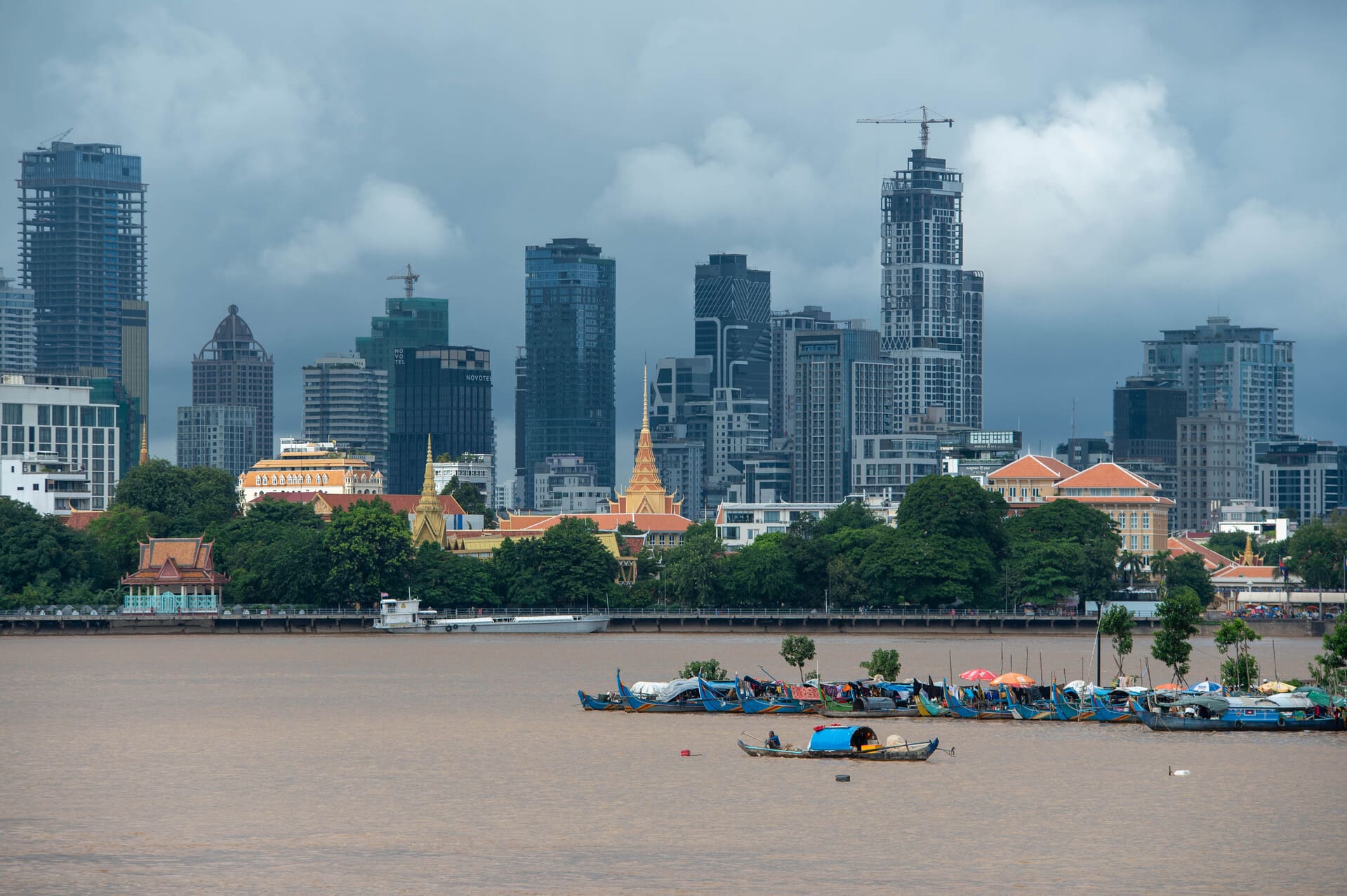
You’ll land at Techo International Airport, Phnom Penh’s brand-new gateway, which opened in September 2025. The drive into the city is a crash course in modern Cambodia: industrial stretches, construction crews, motorbikes stacked with families and goods, street vendors, and a skyline that is under massive transformation, evolving over the last 20 years. My advice is to arrive at least a day before GX starts. I had a full day to shake off jet lag and explore the city on my own, and honestly I wish I had even more!
Where to Stay in Phnom Penh — Rosewood Phnom Penh
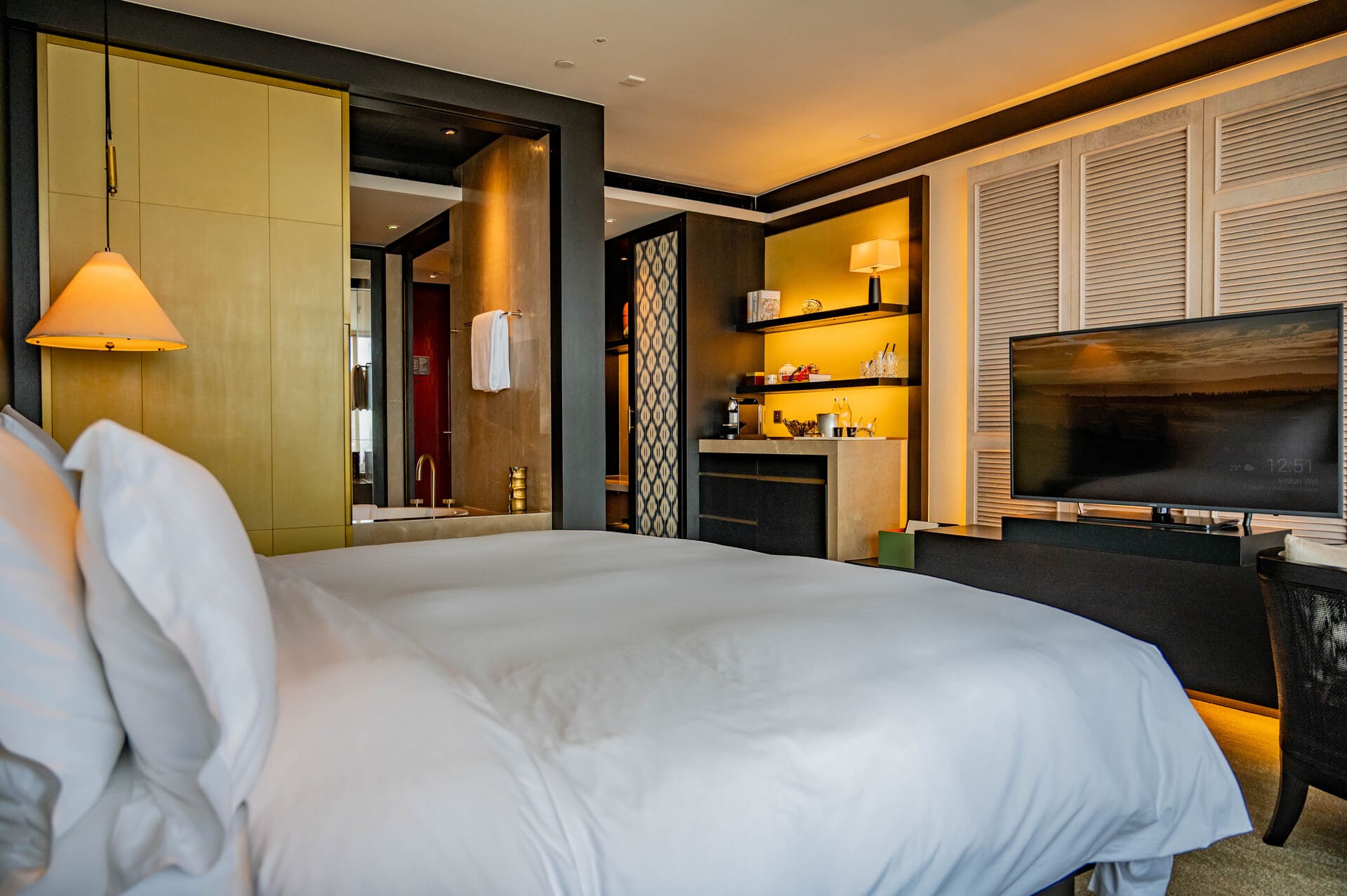
The Rosewood was my first real introduction to Cambodian hospitality, and it set the tone for the whole week. Staff don’t greet you from behind a desk. They come around it to meet you: “Hello, ma’am. Welcome to the Rosewood. Welcome to Phnom Penh. Welcome to Cambodia. We’re so glad you’re here.” Then they walked you to the elevator and pressed the button for you. They seemed to know what we needed before we did, anticipating our needs in a level of hospitality I didn’t know existed. The best part though was that the staff were so genuinely grateful we’d come that I found myself grinning right back at them. Those reciprocal smiles stayed with me all week.
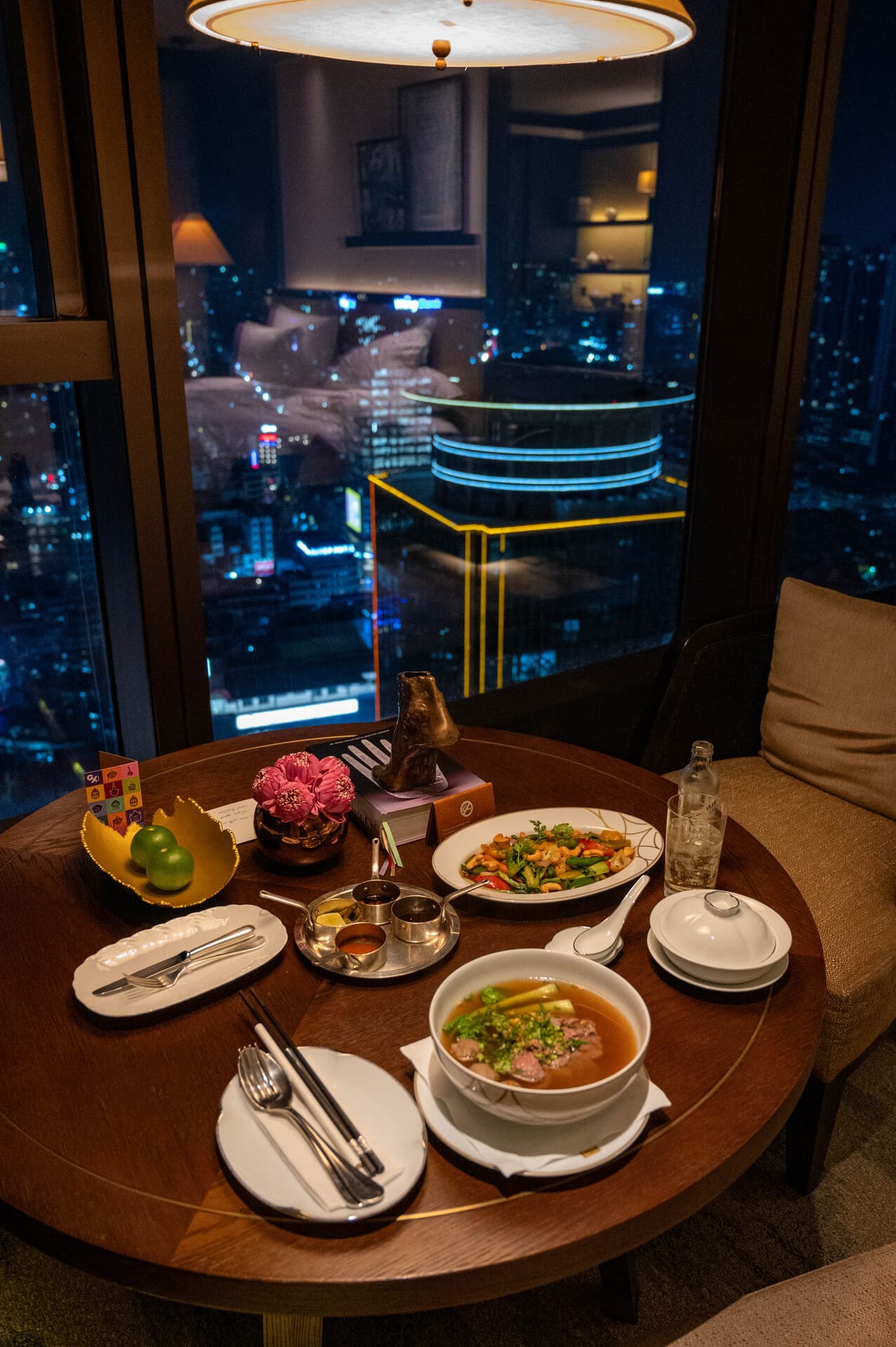
The hotel sits high above the city, with the lobby on the 35th floor, and the views over Phnom Penh that change with the clouds as they move through the sky. My room was five-star elegance with Cambodian design woven through the decor, a huge soaker tub and a shower bigger than my bathroom at home. My favourite moment, though, was simple: ordering room service on my first jet-lagged night, curling up in my pajamas and eating a traditional Cambodian soup Kuy Teav Sach Kor, with side of stir-fried vegetables. It was one of the best meals of the trip, made even better by the evening skyline view.
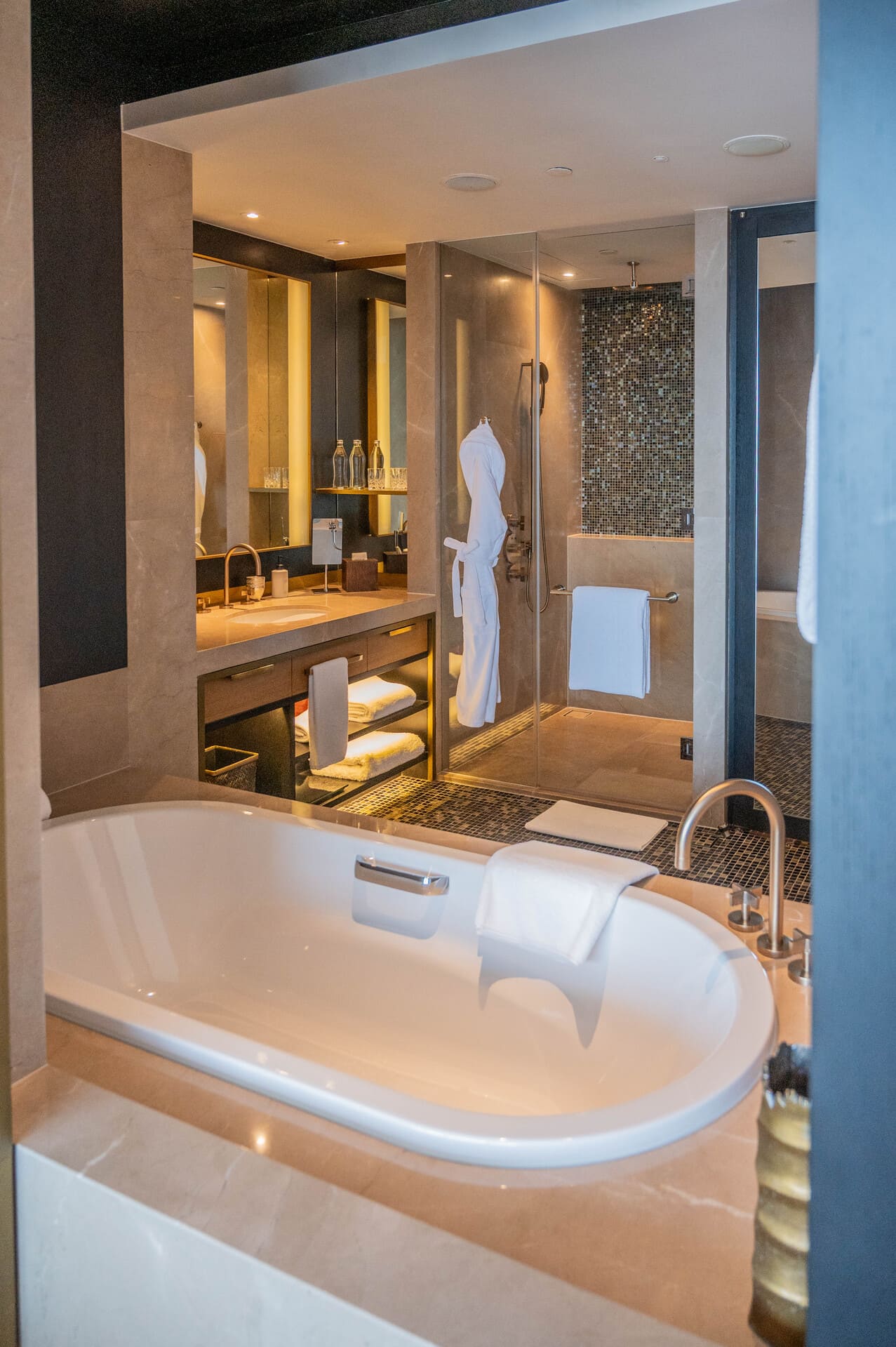
Save room for breakfast, too while staying at the Rosewood. Walking in it’s stimulation overload with fresh-pressed juices, a full hot buffet, a European spread of cheeses, meats and salads, granola and fruit stations, and then an à la carte menu on top of all that in case you somehow still want something else. The honeycomb comes from the hotel’s own partner beekeeper, which tells you something about how this kitchen sources (more on that at dinner on Day 2).
👉 What I Loved: The people. The staff’s warmth, from the moment they came around the front desk to greet me, was my welcome to Cambodia, and it never wavered.
👉 What I’d Change: I wish I’d had more time to enjoy the hotel itself. I never made it to the spa or the sky-high pool. Build in a free afternoon here if you can.
👉 Book Your Stay: Rosewood Phnom Penh, Vattanac Capital Tower, Phnom Penh.
The GX Temple Fair at Wat Phnom
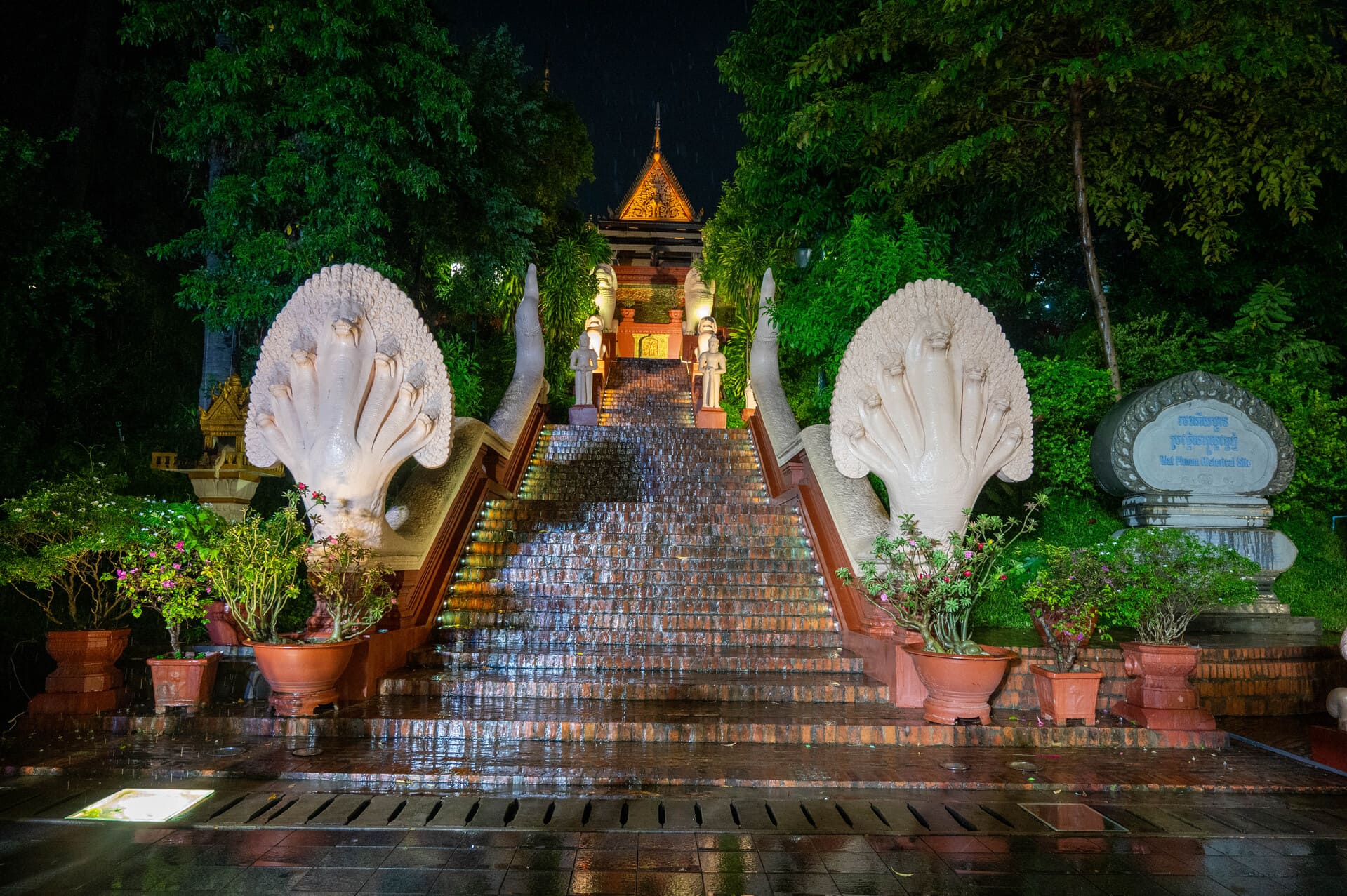
GX launched its official kick-off party in style with a Temple Fair at Wat Phnom, the hilltop temple that gave the city its name. Legend says a woman named Lady Penh found a log floating down the river with Buddhist statues inside it, and her neighbours built a shrine on a hill (“phnom”) to house them. Our local guide warned us to pronounce the P, or we’d be saying the word for cake instead.
Our buses wound through streets that had been closed for us, and it was pouring rain. Nobody cared. It felt like the sky was pouring glitter bombs of pure good energy, because everyone was so excited to be at GX. People lined up at the photo wall, watched the dancers and picked up their custom GX-stamped coconuts.
Dozens of tents circled the temple, each run by a local Cambodian restaurant with chefs cooking right in front of you. It was a micro-buffet crawl: noodles here, soup there, a vegan stall, then traditional desserts. Between bites, you could try traditional flower folding or watch dance performances. In the middle, a big stage hosted singers and dancers under strings of flags and golden lights, with the temple glowing above.
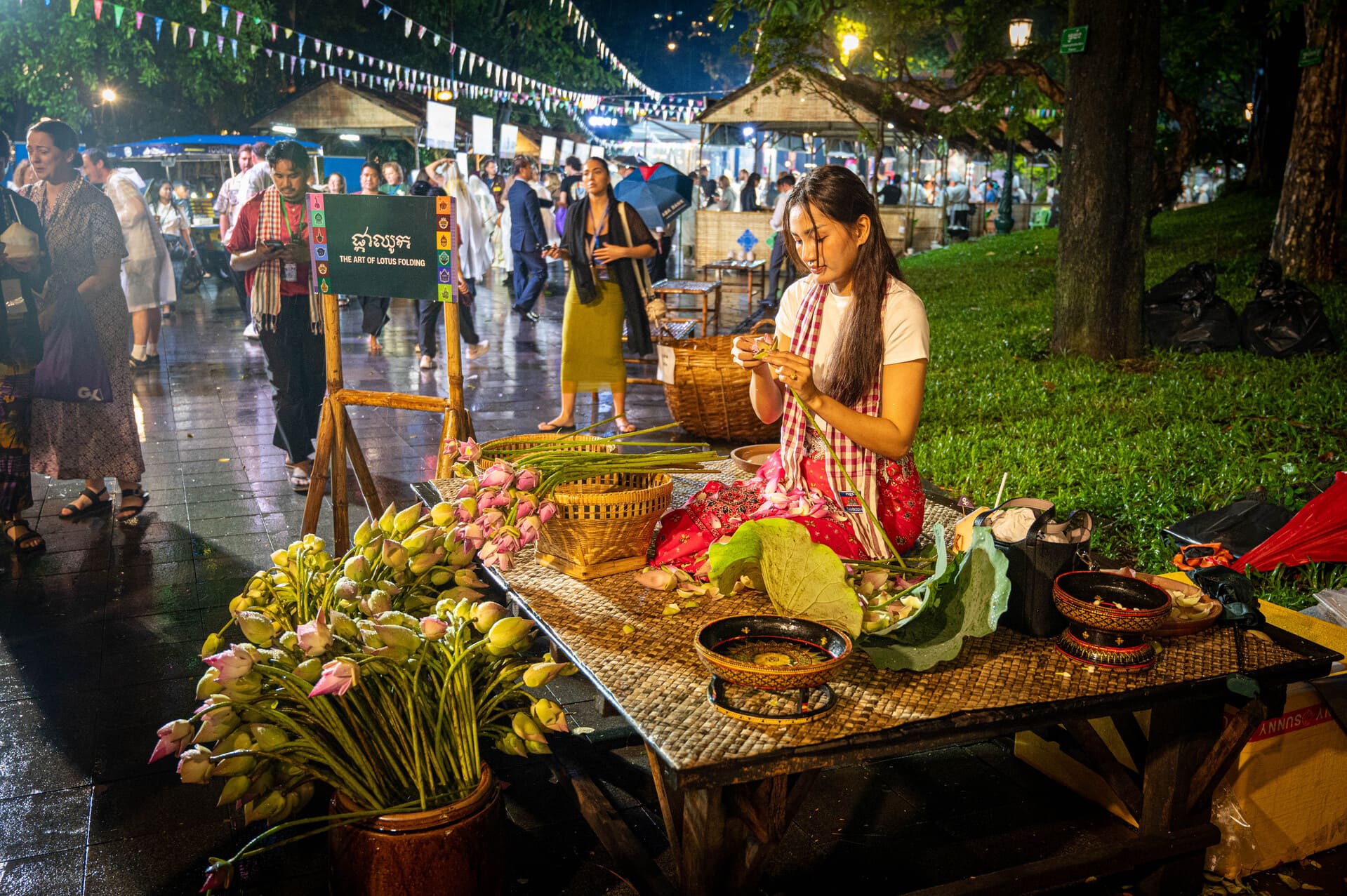
The best part about the kick off party though was the people. I spotted GAdventures staff who spend all year on Zoom were finally hugging in person, and travellers who’d met on Gtrips years ago were reuniting. Watching hundreds of people dance in the streets beneath an iconic temple was the moment I understood what GX really is.
Three Planeterra partners hosted tables: Villageworks, which connects artisans, women and people with disabilities with markets for products made from sustainable and recycled materials; Epic Arts, which uses the arts to champion disability inclusion; and Friends the Restaurant, where former street-connected youth train in hospitality. A Wishing Tree and a Dunk Tank raised money for Planeterra’s community work.
👉 Plan Your Visit: Wat Phnom is open to visitors year-round outside of GX. To eat with a purpose in Phnom Penh, book a meal at Friends the Restaurant. Follow @villageworks_kh, @epicarts_cambodia and @friendstherestaurant to find their shops and support local.
Temple-Ready Tip: Cambodia’s temples and the Royal Palace require covered shoulders and knees. A light scarf over a tank top works, and pants or skirts should reach the knee or below. Pair them with comfortable, grippy shoes, because ancient steps are uneven and can be slippery in the rain. Pack bug spray and a poncho too. These rules apply at every temple stop in this itinerary.
Day 2 — Phnom Penh: Silk, Sorrow and a Palace of Gold
Cruising the Mekong to Silk Island
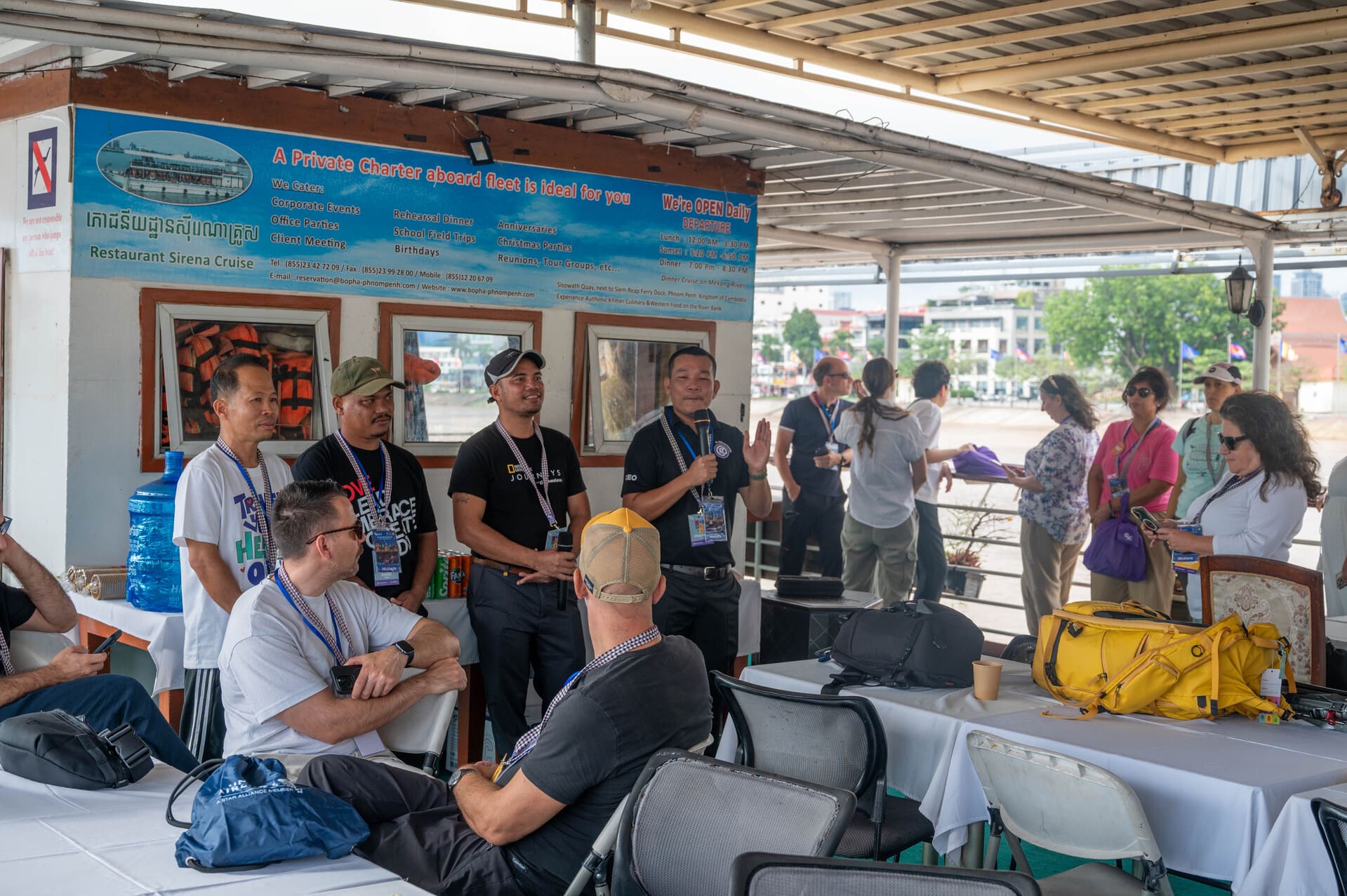
We were on the boat by 7:45 a.m. Just outside the city, four rivers meet at a junction called Chaktomuk: the Upper Mekong, the Lower Mekong, the Bassac and the Tonlé Sap. The Mekong (“Mae” means mother) runs about 4,350 km from the Tibetan Plateau through six countries. The guides teased us all morning about the river’s big secret, which I’ll save for Day 4.
The real gift of that cruise was the stories our GAdventures CEOs (that’s G’s name for its tour leaders) told on the way. Kosal grew up in a stilt village on a Mekong island, rowing the boat while his father fished through the night. Bopha, whose name means “big flower” (his parents were hoping for a girl!), grew up in a silk-weaving village, rocking his little sisters to sleep while his mother spun silk. He left home at 17, trained through New Hope Cambodia, a school and training restaurant that GAdventures and Planeterra helped build in 2009, and has led Gtrips since 2013. Eight GAdventures CEOs have come up through New Hope. When someone tells you travel changed their life, and they’re the one guiding you, you listen differently.
Silk Island Community Centre
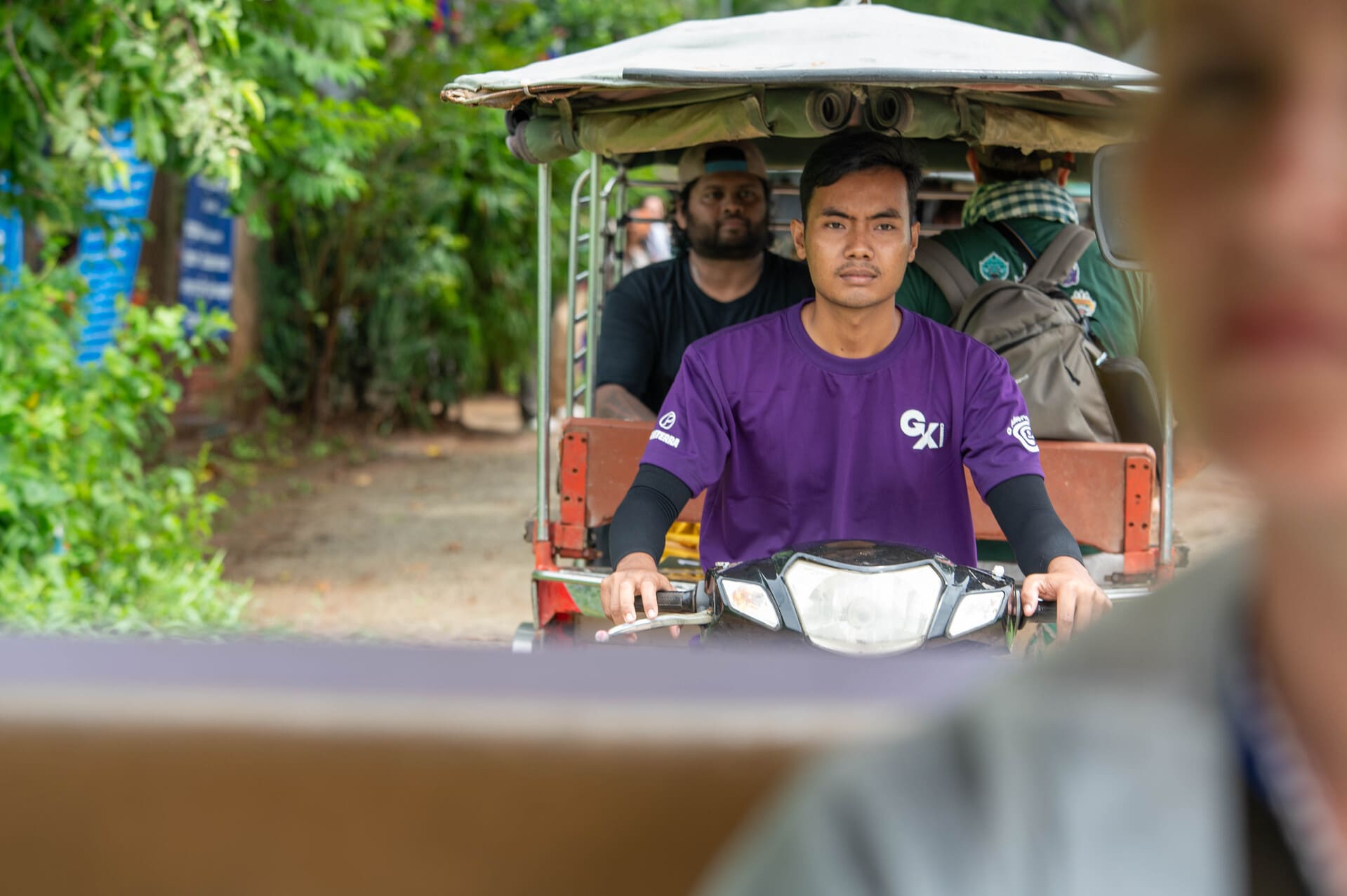
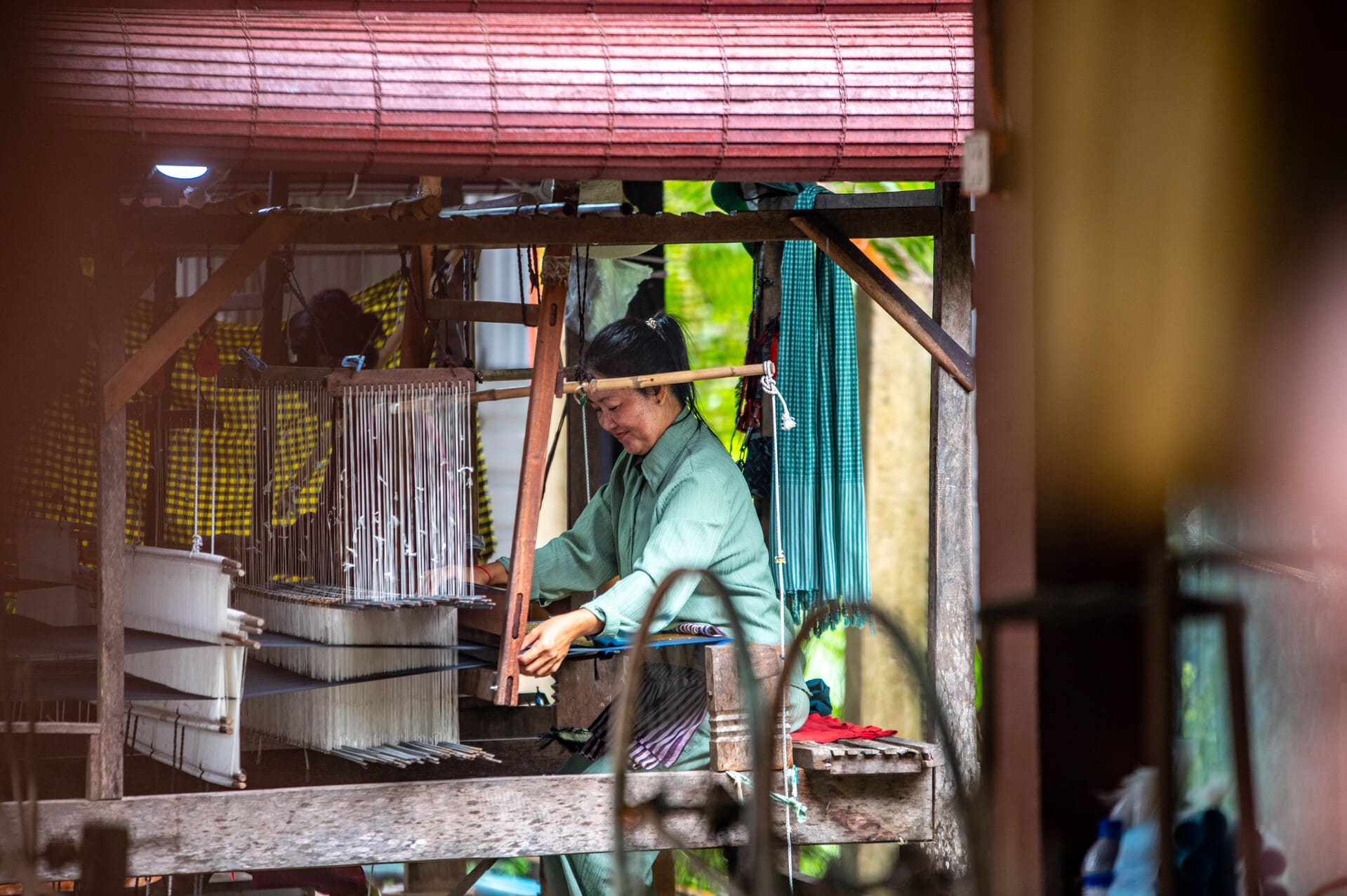
We hopped from the boat into tuk-tuks for the short ride to the Silk Island Community Centre, rain drumming on the roofs the whole way. Around 300 women are connected to the centre: about 30 work on site, and the rest weave from home in the surrounding villages so they can be closer to home. Silk weaving here is passed from mother to daughter. Kong Sokly, one of the artisans, has woven for 13 years and learned from her mother. The craft only survives if young people stay, and the centre’s mission is to make sure the knowledge doesn’t disappear when they move to the city.
This is a learning visit rather than a hands-on workshop. You watch the artisans at their looms and follow the whole process, from silkworms munching chopped leaves to cocoons boiled for their fibre to finished cloth. There was a language barrier, so there was a lot of smiling, hand gestures and help from interpreters, and I took more photos than I can count. Planeterra helped get the centre ready for visitors by repairing two of its looms and adding four new ones.
👉 What I Loved: Watching generations of knowledge move through a pair of hands at the loom, and knowing my visit helps keep that knowledge in the village.
👉 What I’d Change: I didn’t buy anything. There were so many beautiful pieces that I couldn’t decide. I still regret it!
👉 Plan Your Visit: Silk Island Community Centre is one of Planeterra’s newest partners and isn’t on GAdventures itineraries yet. It’s planned for upcoming Gtrips, so you could be among the first to visit.
S-21: Tuol Sleng Genocide Museum
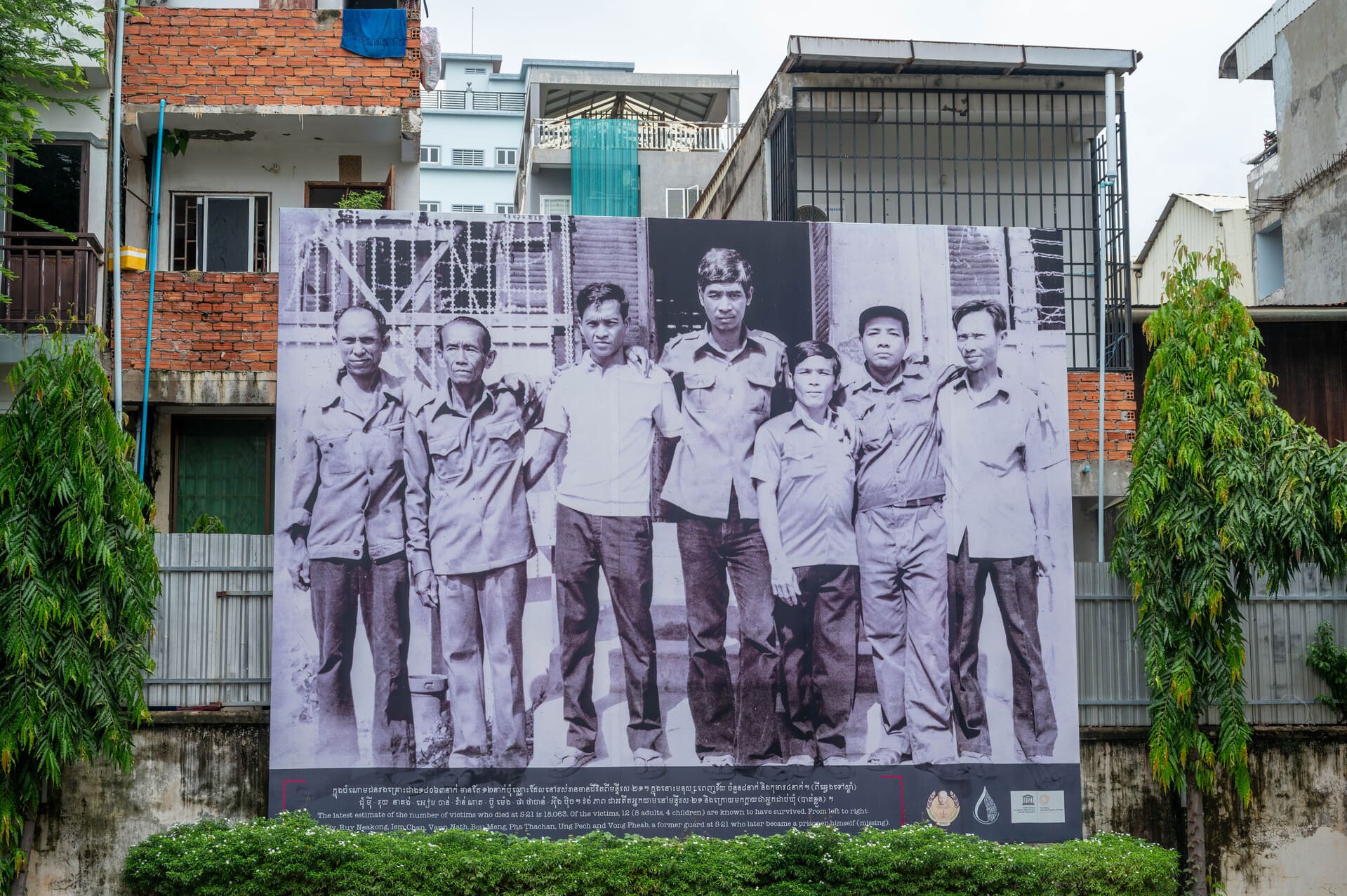
As soon as I said yes to this trip, I knew I had homework to do. I started reading about the Khmer Rouge, who ruled Cambodia from April 1975 to January 1979. According to Encyclopedia Britannica, an estimated 1.5 to 3 million people died under their regime, roughly a quarter to a half of the country’s population. Among the first people they targeted were the educated: teachers, doctors, even people who wore glasses or “sound smart”.
S-21 was originally a high school and overnight the Khmer Rouge transformed it into a prison. It’s hard to put into words what it means to stand where so many lives were taken, or moved through on their way to the killing fields. A school is supposed to be the safe heart of a community, and the symbolism of turning one into a place of torture is crushing. Colleagues cried. Most of us walked in silence, processing the cells, the photographs and the remains. In 2025, S-21, the Choeung Ek killing field and the M-13 prison were inscribed together as a UNESCO World Heritage site.
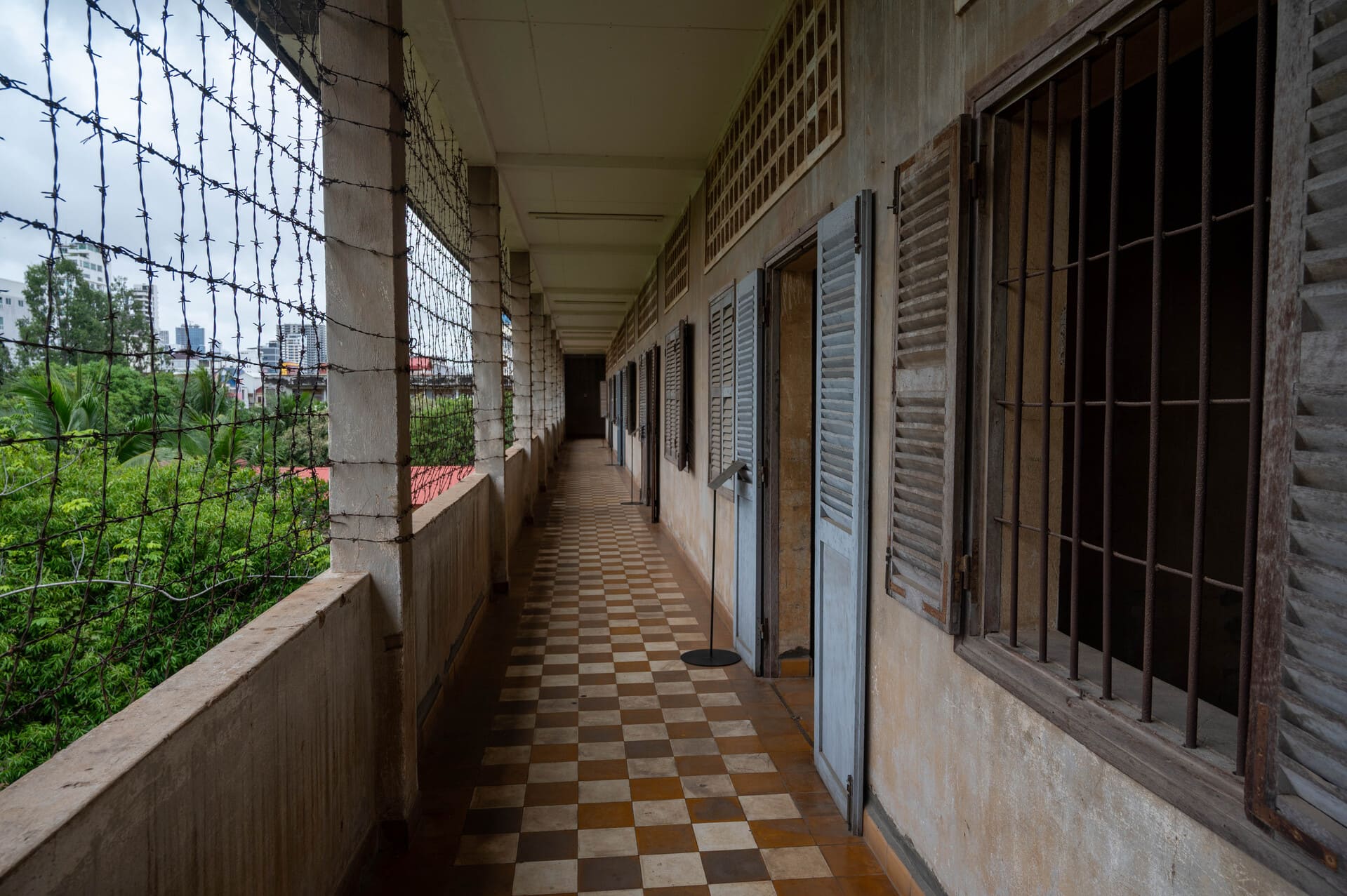
Here’s the lesson I took home: the research made the visit more meaningful. I’ve never studied a country’s history this closely before a trip, and it changed everything about how I saw Cambodia, both at the historic sites and on the street. I noticed how many people in the generation that survived were missing limbs or carried visible injuries. And I saw resilience everywhere. These are fighters, and their country is moving from surviving to healing to thriving. That’s exactly where tourism, done with the right partners, can be a catalyst for good.
👉 Plan Your Visit: Tuol Sleng Genocide Museum (S-21), Phnom Penh.Before you go, read A Refugee’s American Dream by Leth Oun and Joe Samuel Starnes, and First They Killed My Father by Loung Ung.
The Royal Palace
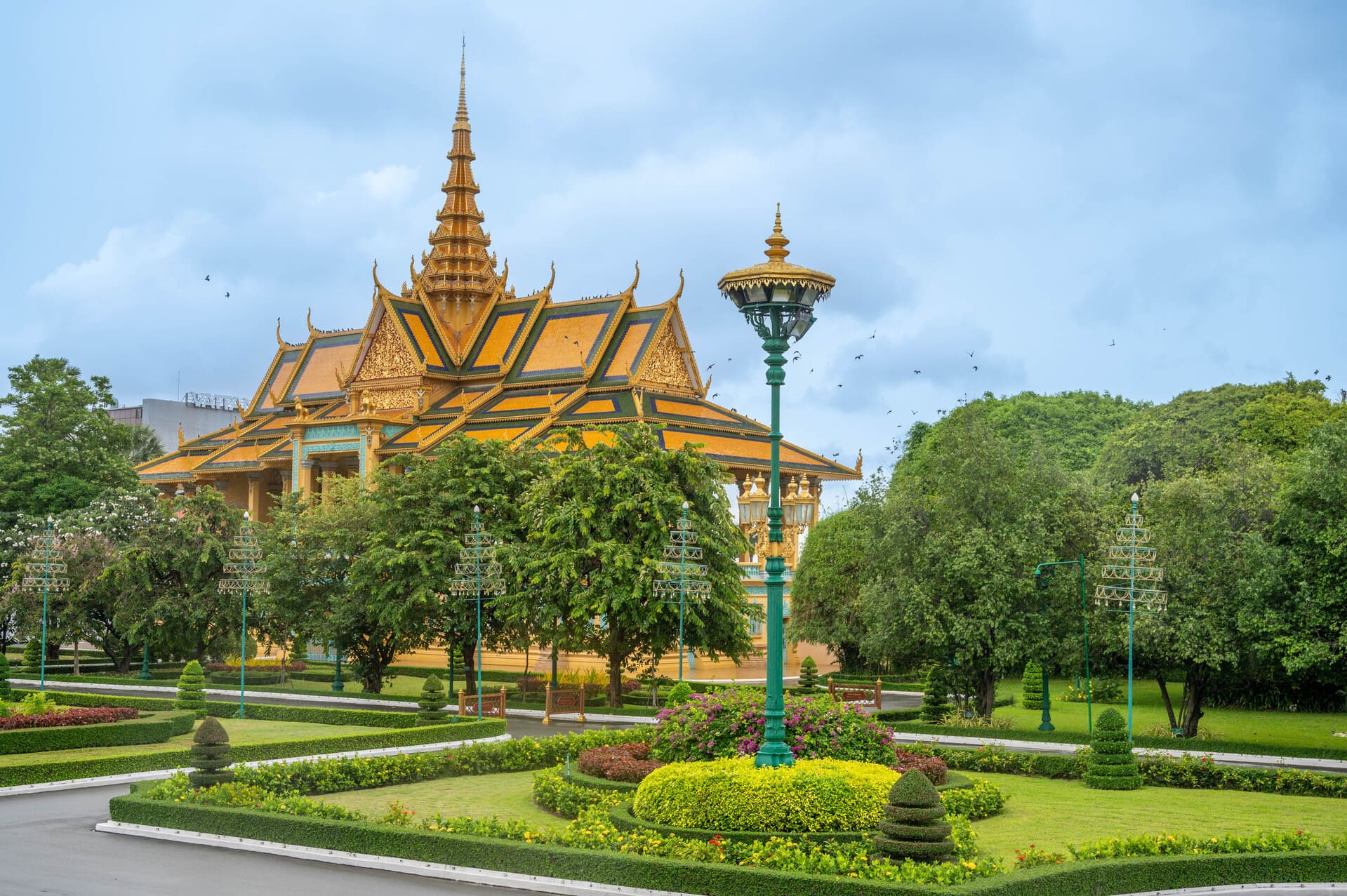
An hour later, we walked into the Royal Palace, and the contrast took my breath away. After the grey corridors of S-21, here were gilded spires, bright colours and manicured gardens, with the grandeur of the Taj Mahal or Buckingham Palace. The complex includes the famous Silver Pagoda, and much of it is still a working royal residence, so only part of it is open to visitors. I’ll be honest: this was more of a visual stop than a deep history lesson, and after the morning we’d had, that felt like exactly what we needed.
👉 Plan Your Visit: Royal Palace, Phnom Penh. Dress code is strictly enforced.
Where to Eat in Phnom Penh: Brasserie Louis at the Rosewood
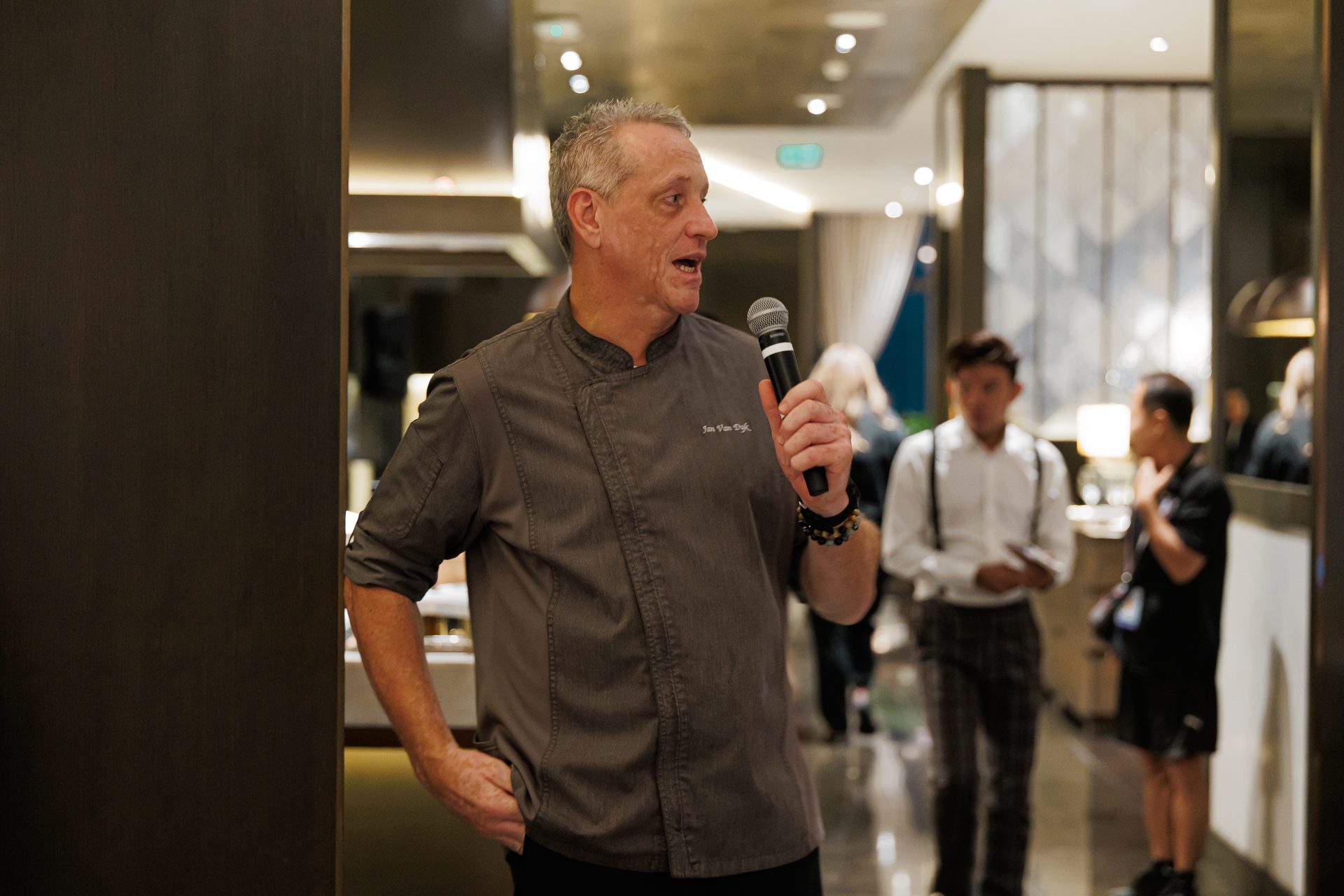
Dinner was 35 floors up at Brasserie Louis, and it came with one of my favourite stories of the trip. The hotel’s Chef once flooded his motorbike in a river in the mountains and got stranded in a village where no one spoke English. A woman disappeared with a chicken and came back 45 minutes later with a chicken stew and the most fragrant rice he’d ever tasted. He pinned the location on his phone. Today, the hotel says it buys rice directly from eight farming communities, paying $2.20 a kilo instead of the roughly 60 cents farmers used to get, and families are sending their kids to school instead of the fields.
That philanthropic leadership runs through the whole menu. The hotel contracts small farms at market price, smokes its own fish, makes its duck consommé from the bones of the roast ducks, and melts down old candle stubs with pandan from the garden to make new candles. Its empty glass bottles go to the Coconut School in Mondulkiri, which builds school walls out of them.
And then there was the company. I ended up sitting across from Bruce Poon Tip, a few hours after my one-on-one interview with him. Breaking bread with one of the true visionaries of our industry, in an informal setting where he could just be himself, is something I’ll never forget. At GX, that’s the kind of moment that can just happen, and Bruce tries hard to connect with as many people as possible. But to sit directly across from him… inspiring!
👉 Plan Your Visit: Brasserie Louis, 35th floor, Rosewood Phnom Penh. Reservations recommended; mention any allergies when you book.
Day 3 — Phnom Penh to Siem Reap: Temples Older Than Angkor
The Drive North
We left Phnom Penh at 7:05 a.m. and sent our big bags ahead to Siem Reap, so all we carried on the coach was a daypack. Pack yours with everything you’ll need for the day: your camera and laptop, temple clothes, bug spray and a poncho. It’s roughly five hours to Sambor Prei Kuk with a mid-morning rest stop, and another three-plus hours on to Siem Reap.
Sambor Prei Kuk
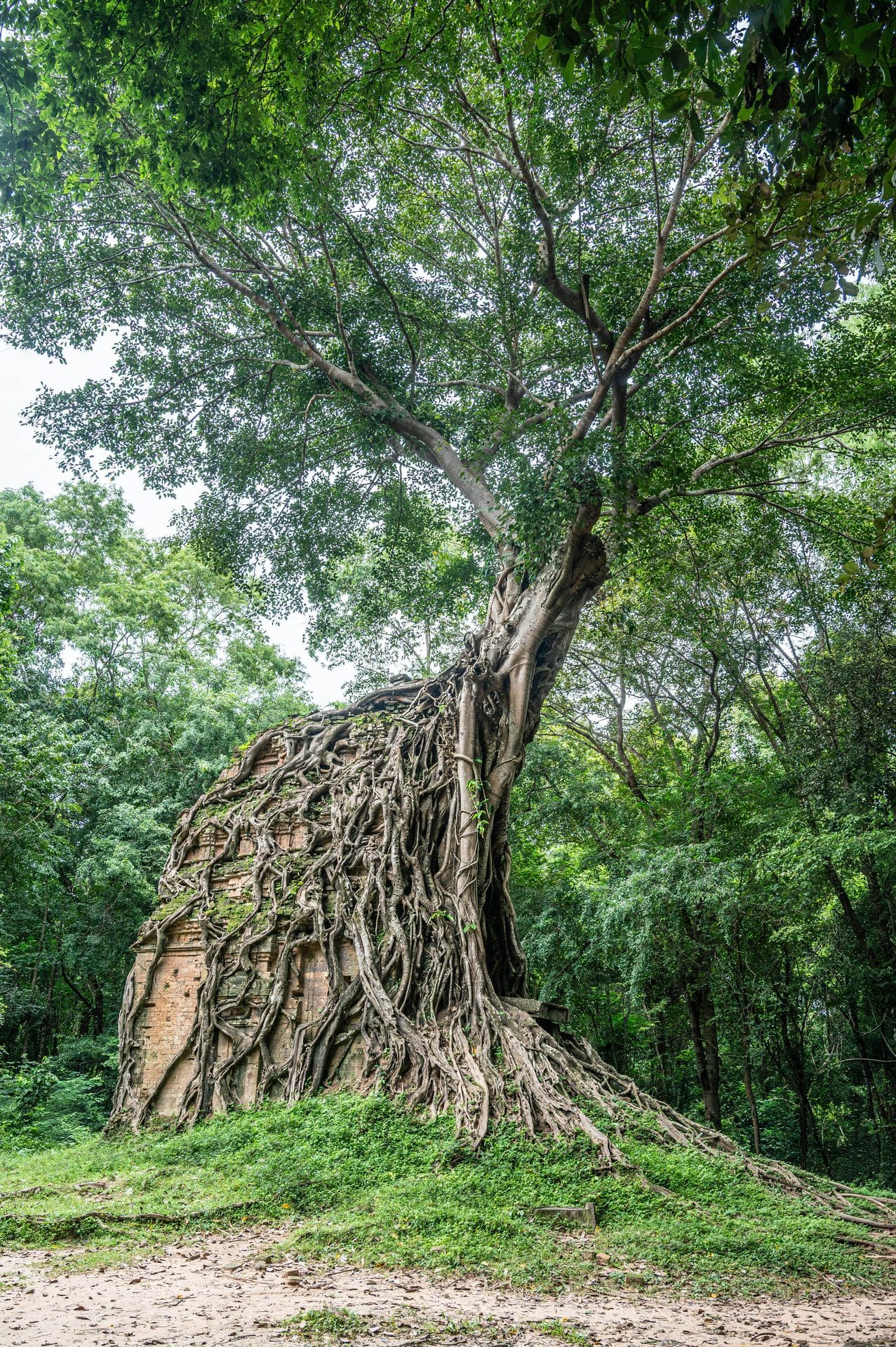
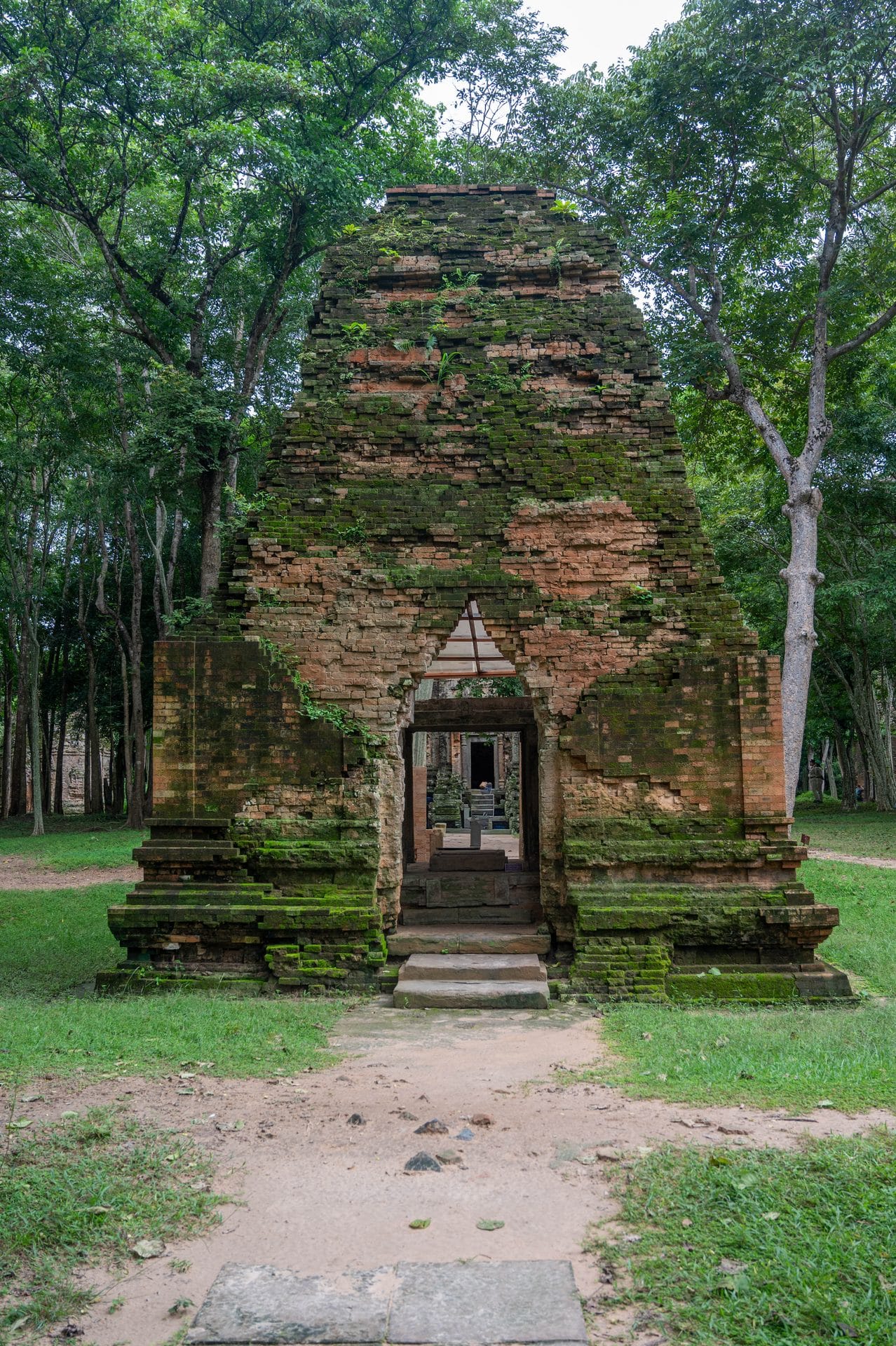
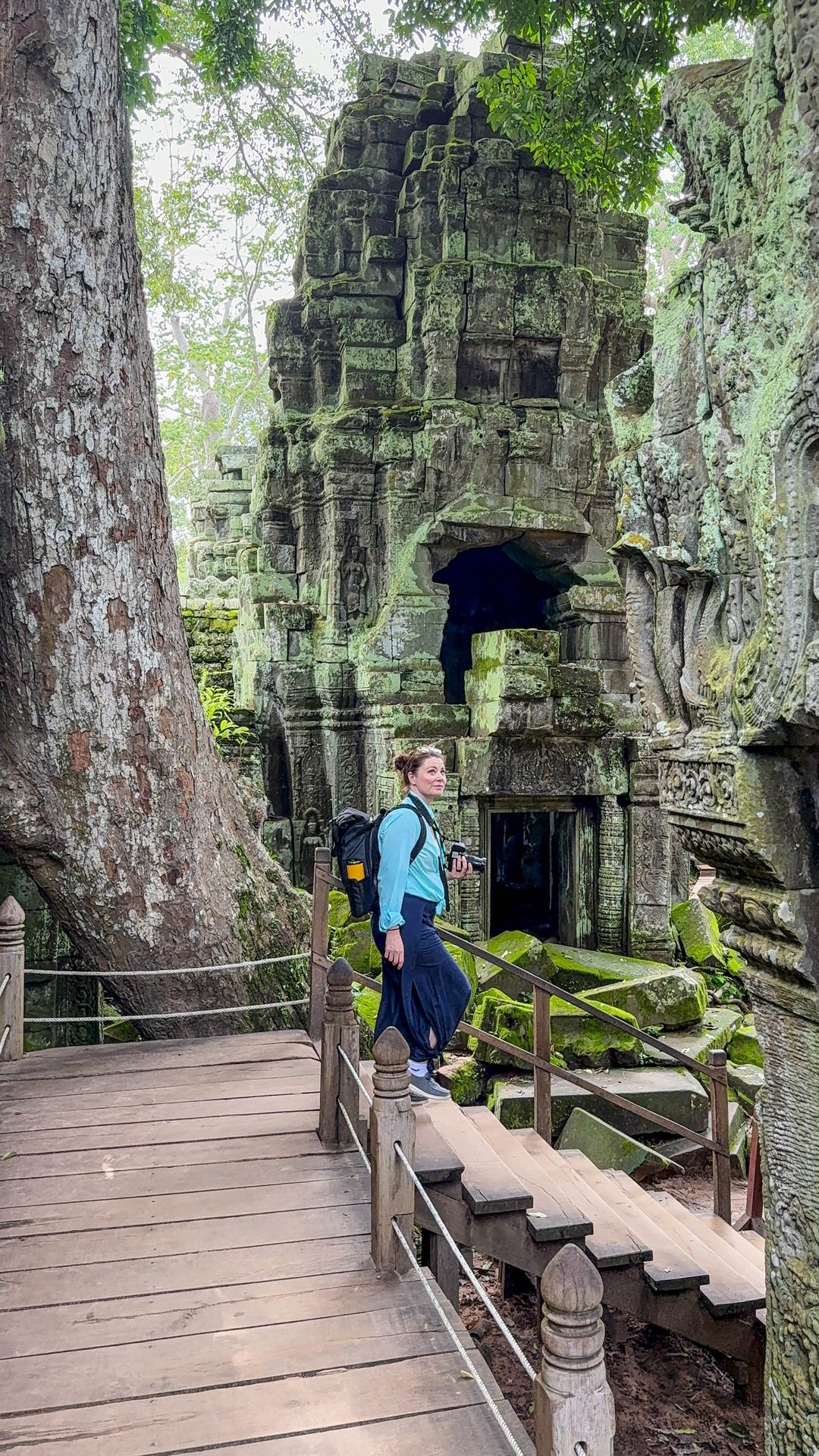
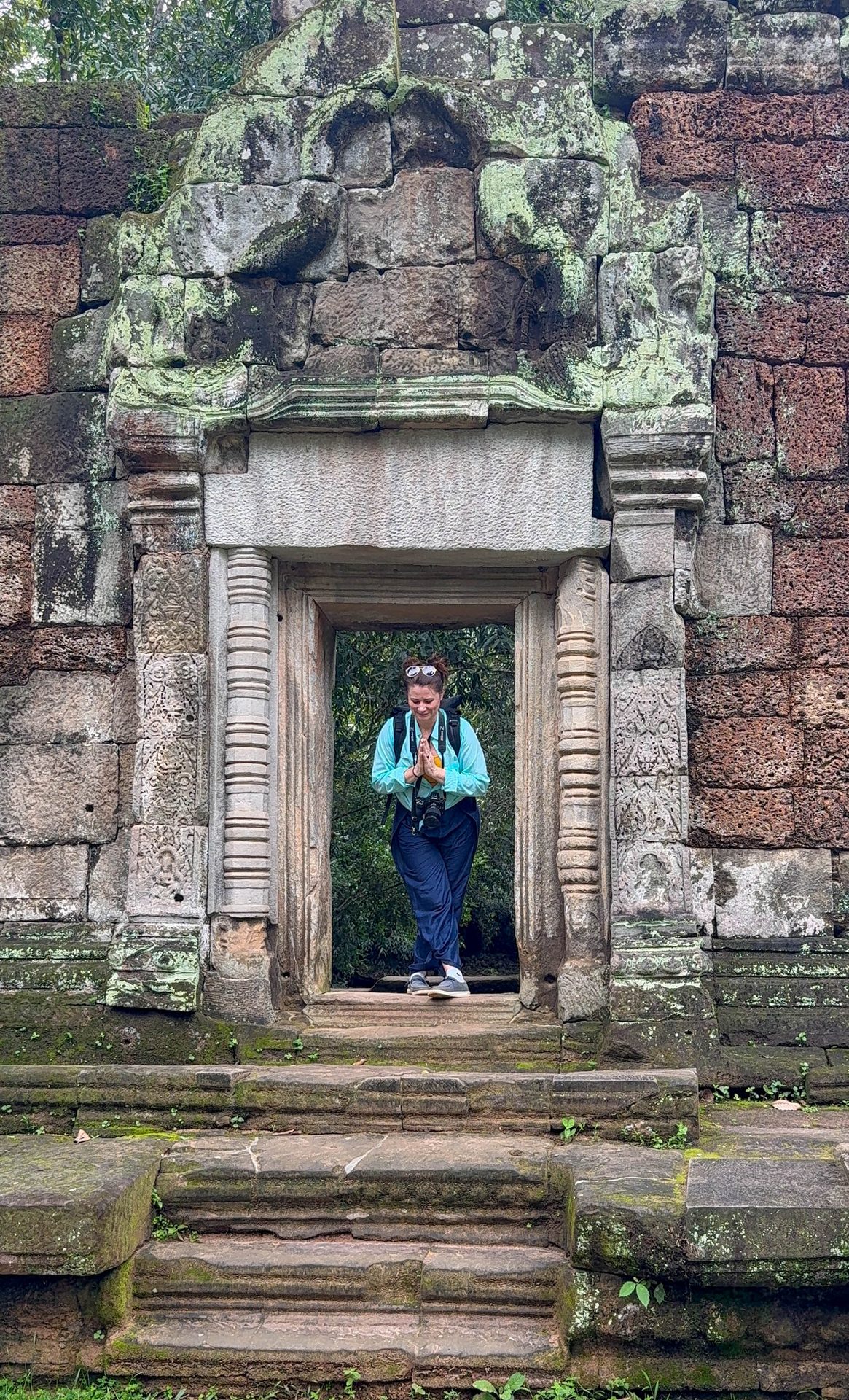
Sambor Prei Kuk was our first temple, and it’s a powerful place to start. This was Ishanapura, a royal capital built in the 7th century, centuries before Angkor Wat. It was inscribed as a UNESCO World Heritage site in 2017, and the wider area holds close to 300 temples. These are brick towers with carved lions and stone pedestals, standing after roughly 1,400 years of weather, wars and looting.
What moved me most is that these temples are caught between what they were and what they’re becoming. Mother Nature is reclaiming them: thick moss climbs the walls, and in one spot a tree has wrapped its roots around an entire temple. Yet they still stand, and you can still walk through them. Travelling with media usually means a loud, rambunctious group, but here we went quiet. Everyone just wandered, reflected and soaked it in.
Lunch and a Homestay with Sambor Prei Kuk Community-Based Tourism
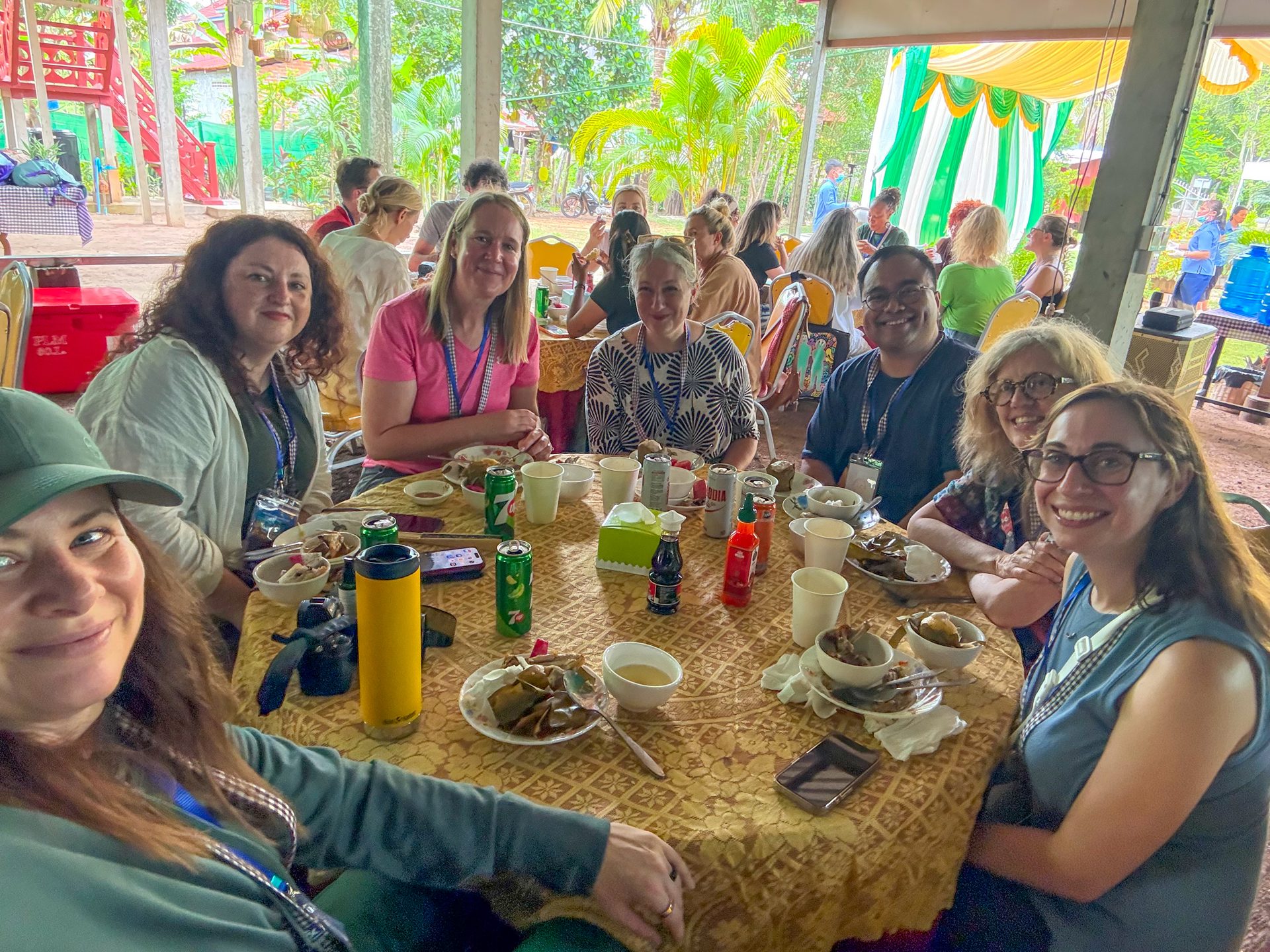
Lunch was hosted by Sambor Prei Kuk Community-Based Tourism, an association that works with the seven villages around the site, home to about 8,000 people. Community members work as guides, cooks, koyun (tractor-cart) drivers, craftspeople and homestay hosts, so tourism income spreads well beyond the temple gates. GX support helped improve the community restaurant and paid for 10 koyun seats and a new welcome sign.
We ate outdoors at long tables: a buffet of soups, salads, fried rice and chicken, with local vendors selling baskets, silk and nuts, and fresh popsicles being made on the spot. Our host, Khee Pearum, took us upstairs to see the homestay: four simple bedrooms with mosquito nets, raised above the ground, with basic washrooms below. You too can stay here for US$6 / night for up to 4 people Tem Buntang, the association’s vice president, told us what tourism means for the villages, and Deputy Community Leader Krouch Sodany (“Dany”) has been guiding here since 2007.
This isn’t a five-star experience, and that’s exactly what makes it special. If you want to truly understand a place, I think the right balance is big-city luxury when you land, then getting out into small communities and connecting at a grassroots level. That’s what community tourism is, and it’s where transformational travel happens.
👉 What I Loved: Eating local food under the open sky with the families who cooked it, then seeing how simple and welcoming a homestay can be.
👉 What I’d Change: Our schedule was tight, so we missed the koyun ride and the traditional cake-making. If you’re travelling independently, give Sambor Prei Kuk a full day, or stay the night.
👉 Book Your Tour: Sambor Prei Kuk Community-Based Tourism, Kampong Thom Province. Guides, homestays, koyun rides and meals can be arranged through the association. https://kampongthom.tourism.gov.kh/stay
Where to Stay in Siem Reap — Raffles Grand Hotel d’Angkor
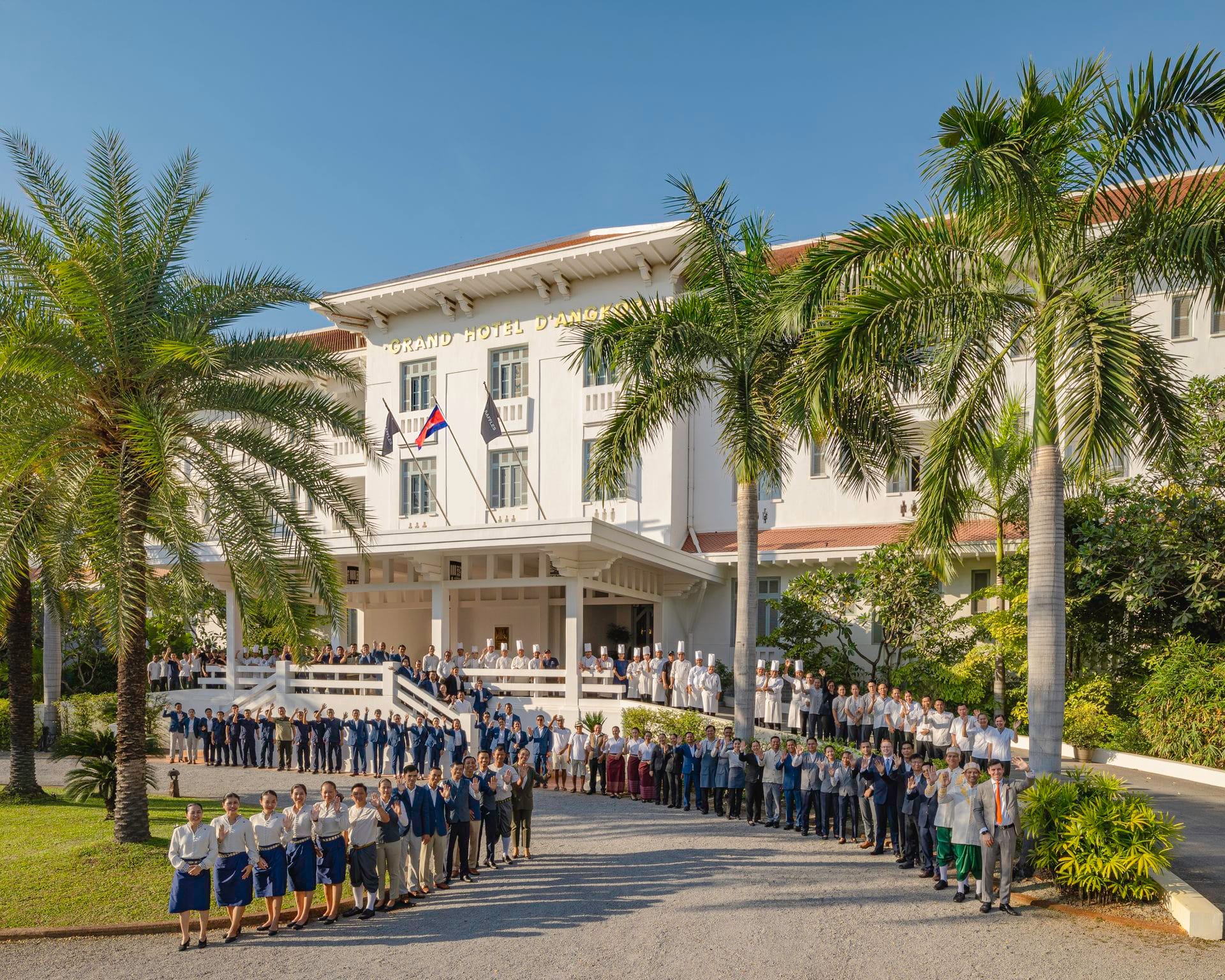
We heard the Raffles before we saw it. As our buses pulled up, drums thundered from the top of the steps, so we ran up them and found the MeDha Cambodia, a troupe of women drummers welcoming us with big drums and bigger smiles. Our faces were filled with wonder and awe that can only happen when you’re surprised and welcomed in such a fashion.
The Raffles Grand Hotel d’Angkor is one of Asia’s grand heritage hotels, which looks like it stepped straight off the cover of Travel + Leisure. An army of staff whisked us inside, greeting us with scarves, drinks, and room keys, then walked each of us to our rooms. Mine came with a butler, Nak, who looked after me so kindly and generously all week, right down to booking my hair and makeup for the final gala evening.
While the whole hotel is magnificent, breakfast deserves its own shout-out as it is elegant and opulent, with a lavish buffet and an à la carte menu available. I write about a lot of hotels, and visit many properties every year. The Raffles was special and unforgettable, and now that I’m home and reflecting, it was especially so because of the staff, who were so welcoming and kind.
👉 What I Loved: Nak’s thoughtful care, and that first-night welcome with the drums echoing off the steps.
👉 What I’d Change: I didn’t discover the hotel’s enormous pool, with its loungers and hot tub, until my last day. Make time for it. Guests can also borrow bamboo bikes for free, which I only found out about after I’d left.
👉 Book Your Stay: Raffles Grand Hotel d’Angkor, Siem Reap.
Day 4 — Siem Reap: Sunrise, Tuk-Tuks and a Lake That Changes Shape
Riding with Tuk Tuk Lady Driver
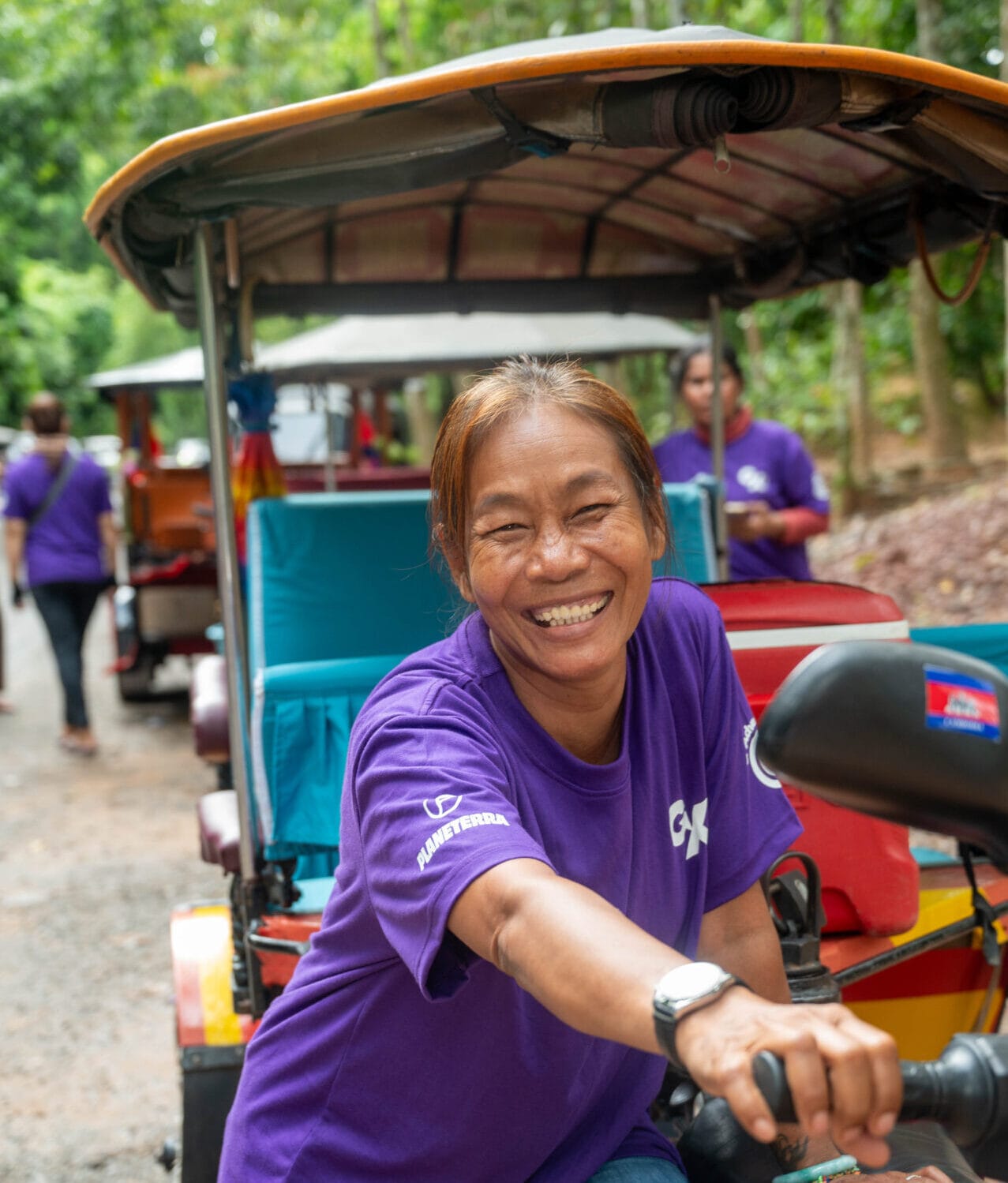
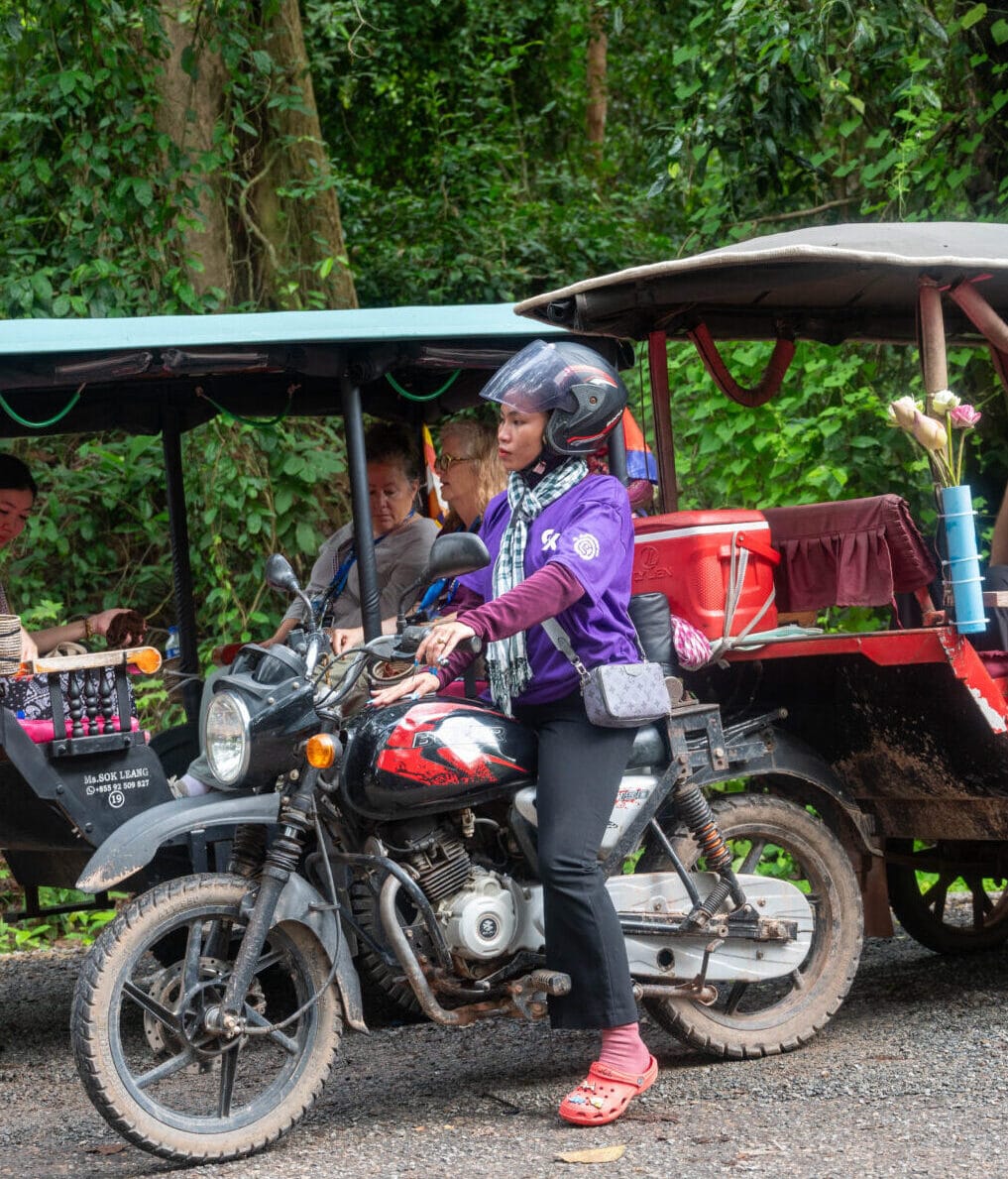
At 4:15 a.m. we stumbled outside to a roar of cheering. Our tuk-tuk drivers, all women from Tuk Tuk Lady Driver, were so excited that it felt like a family reunion. “Come on, pick me, pick me!” My driver’s name was Mom, and I loved her immediately. Signs on the back of the tuk-tuks read things like “This tuk runs on good vibes” and “This tuk-tuk has a female driver,” and everyone was wearing their GX T-shirts as we rattled through dark streets for the roughly 20-minute ride to Angkor Wat.
Tuk-tuk driving in Cambodia has traditionally been a man’s job. Kim Sokleang became one of the country’s pioneering women drivers, then built that same opportunity for other women. Today the association has 25 women drivers. Planeterra has supported training, mentorship and uniforms, and GAdventures has been bringing travellers since 2023. Look for the QR code inside your tuk-tuk to read your driver’s story.
👉 Book Your Tour: Tuk Tuk Lady Driver, Siem Reap. Book a driver for temple days, airport transfers or getting around town. The drivers are also included on GAdventures’ Signature: Laos and Cambodia’s Ancient Traditions trip. https://www.tuktuklady.com/
Angkor Wat at Sunrise
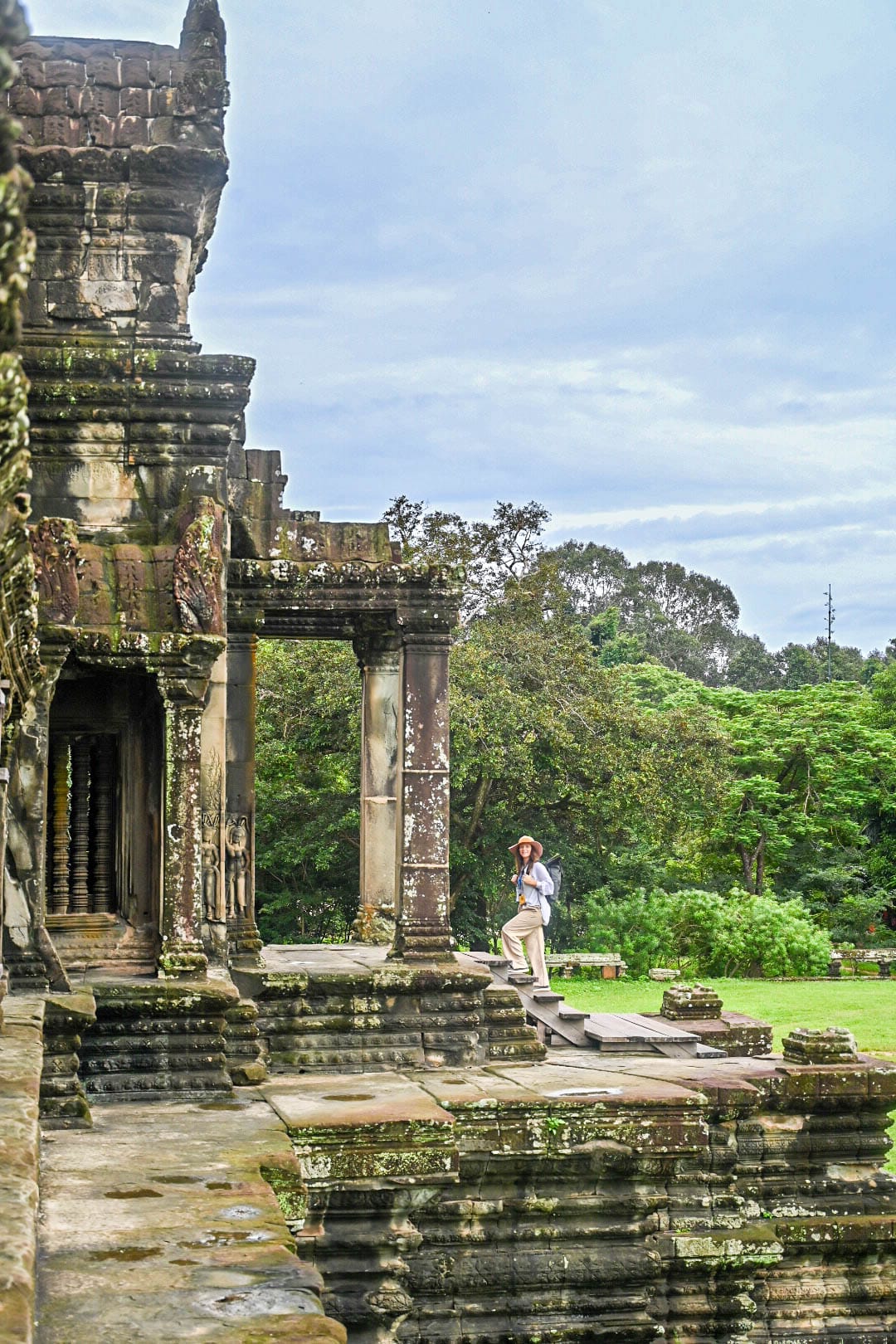
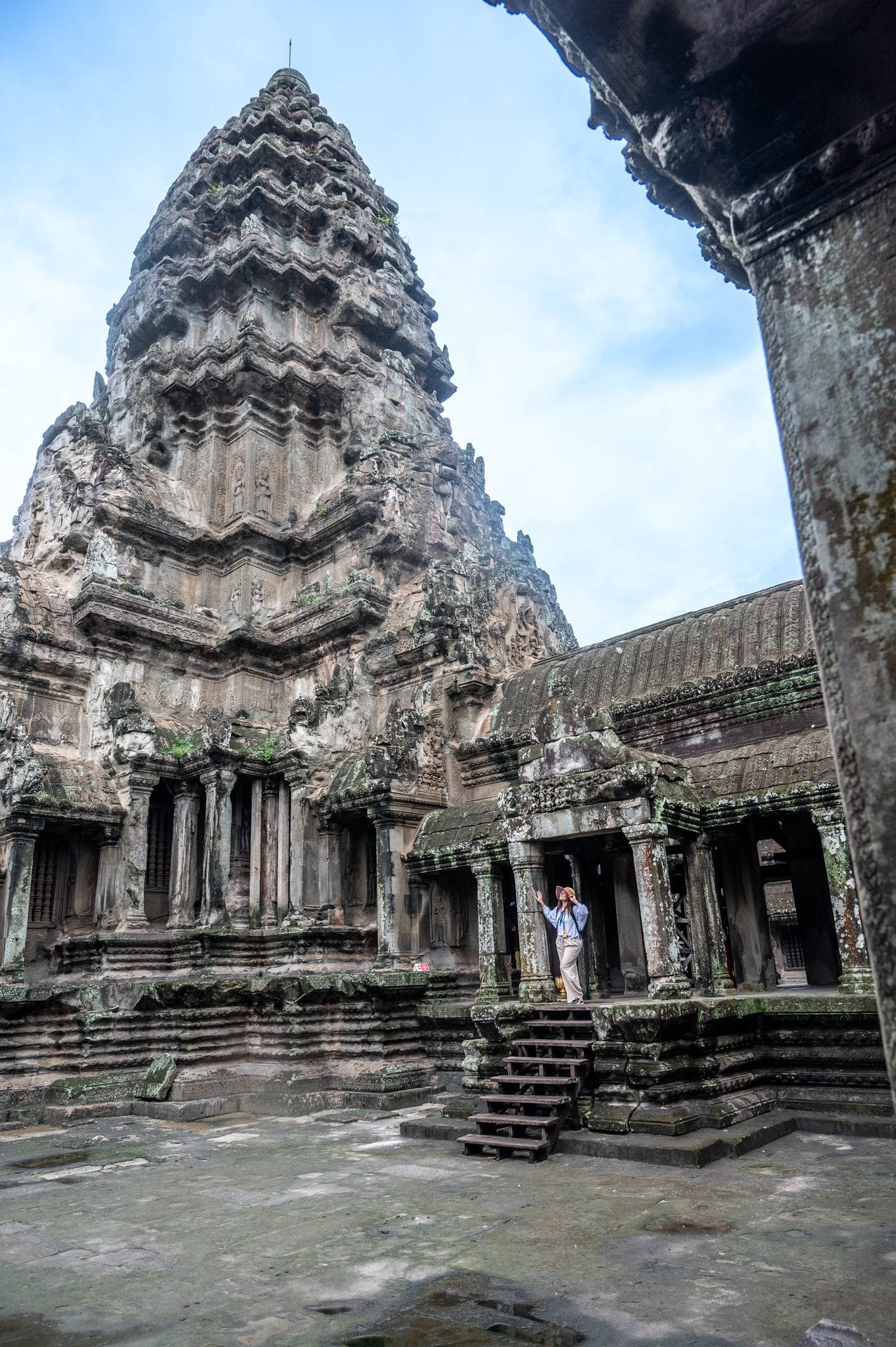
Let’s clear up one thing first: “Angkor” is the whole UNESCO-listed archaeological park, about 400 square kilometres of temples and ancient city, and Angkor Wat is just one temple within it, built in the 12th century. Sunrise there is a bucket-list moment, and I hyped it up in my head for months.
Our morning was cloudier than I’d hoped. I stayed outside the gates, and I wish I’d gone in to the reflecting pools closer to the temple, where the classic photo is. So no, I don’t have that famous postcard shot, and I felt a little deflated. That’s the danger of hyping up something you can’t control. By the end of the day though I had hundreds of photos I loved, so here’s my tip: get to the reflecting pools early, and don’t let one photo make or break your morning.. Most visitors buy a three-day or seven-day pass, and I’d recommend it.
As a creator, I could have joined the photography-focused group that morning. Instead, I stayed with the storytellers for a private tour with Bradley Gordon. Brad is a lawyer and Legal Advisor to Cambodia’s Ministry of Culture and Fine Arts, and he has spent more than a decade recovering Cambodia’s looted antiquities from museums and private collectors around the world. One line of his stuck with me: “We don’t pay for stolen items.” This is where you move from being a tourist who snaps a photo and says “I was here” to being a traveller who learns the history, including the history still being written today.
Walking those halls, I kept imagining what Angkor Wat looked like at its height, with its statues in place and a whole civilization moving through it. Someday I hope someone builds an immersive tour that lets us see it that way.
👉 What I Loved: Hearing first-hand from the man bringing Cambodia’s stolen treasures home, while standing in the temple they came from.
👉 What I’d Change: I’d go inside the gates to the reflecting pools for sunrise, and I’d give Angkor at least two full days.
👉 Book Your Tour: Brad’s tour is exclusive to GAdventures’ National Geographic Signature Cambodia trip, with first departures in January 2027. Learn More ➜
Where to Eat in Siem Reap: SPOONS
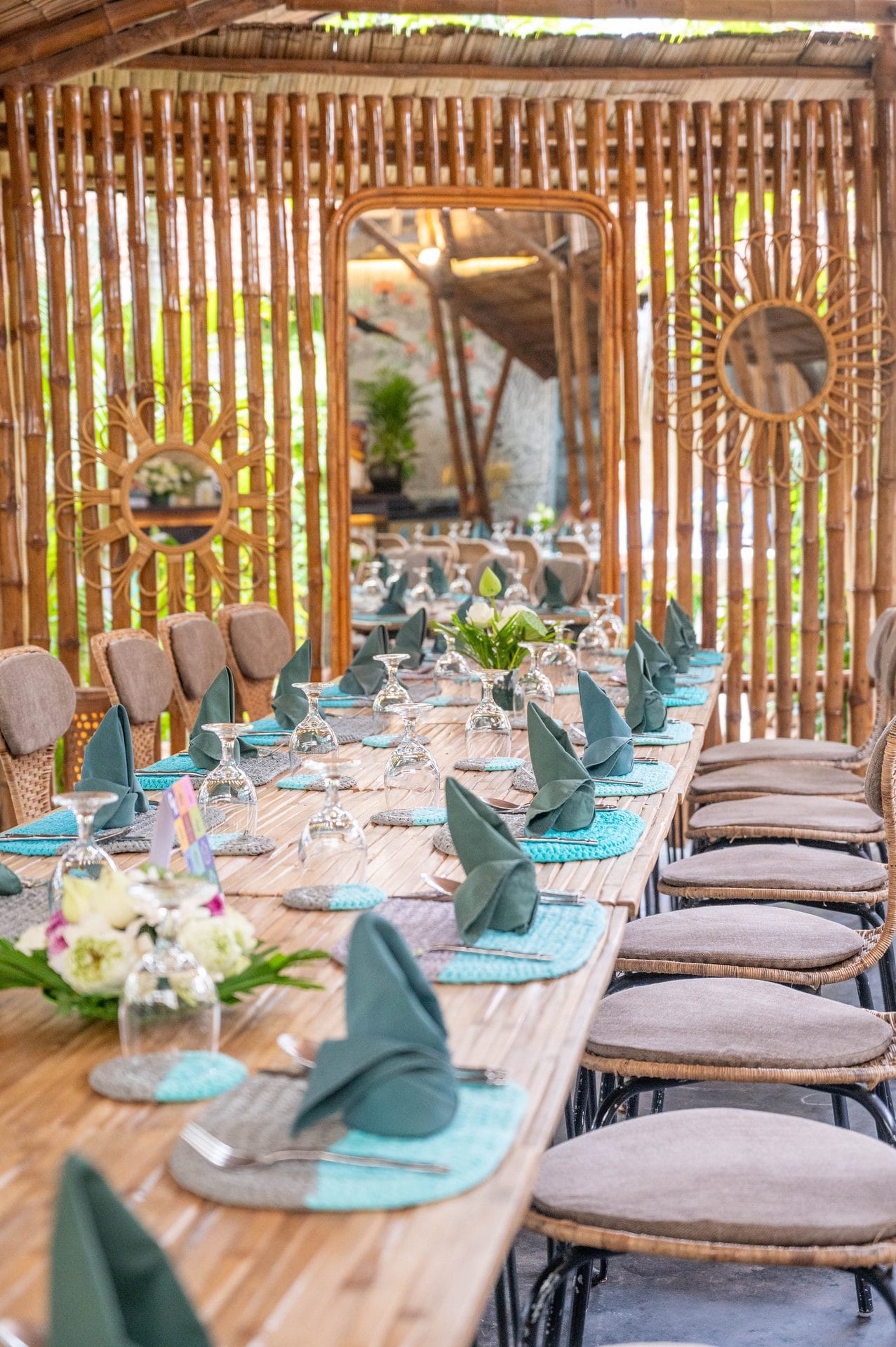
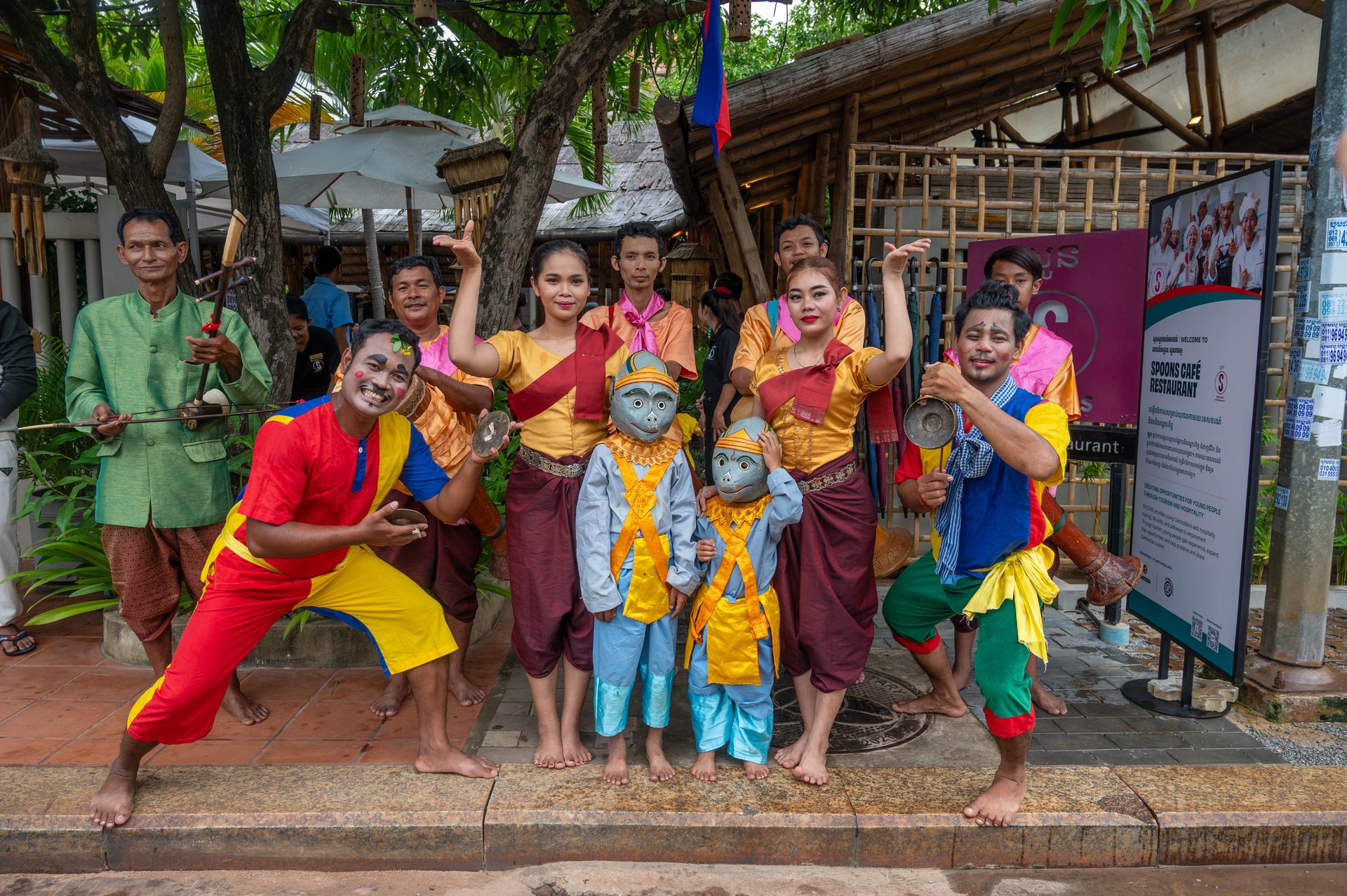
Lunch at SPOONS started before we even reached the door. Singers and dancers in bright costumes, including little kids doing a monkey dance, greeted us with huge smiles. This didn’t feel like a show put on for tourists. It felt like mutual respect: everyone bowing, thanking each other, and seeing the magic in one another.
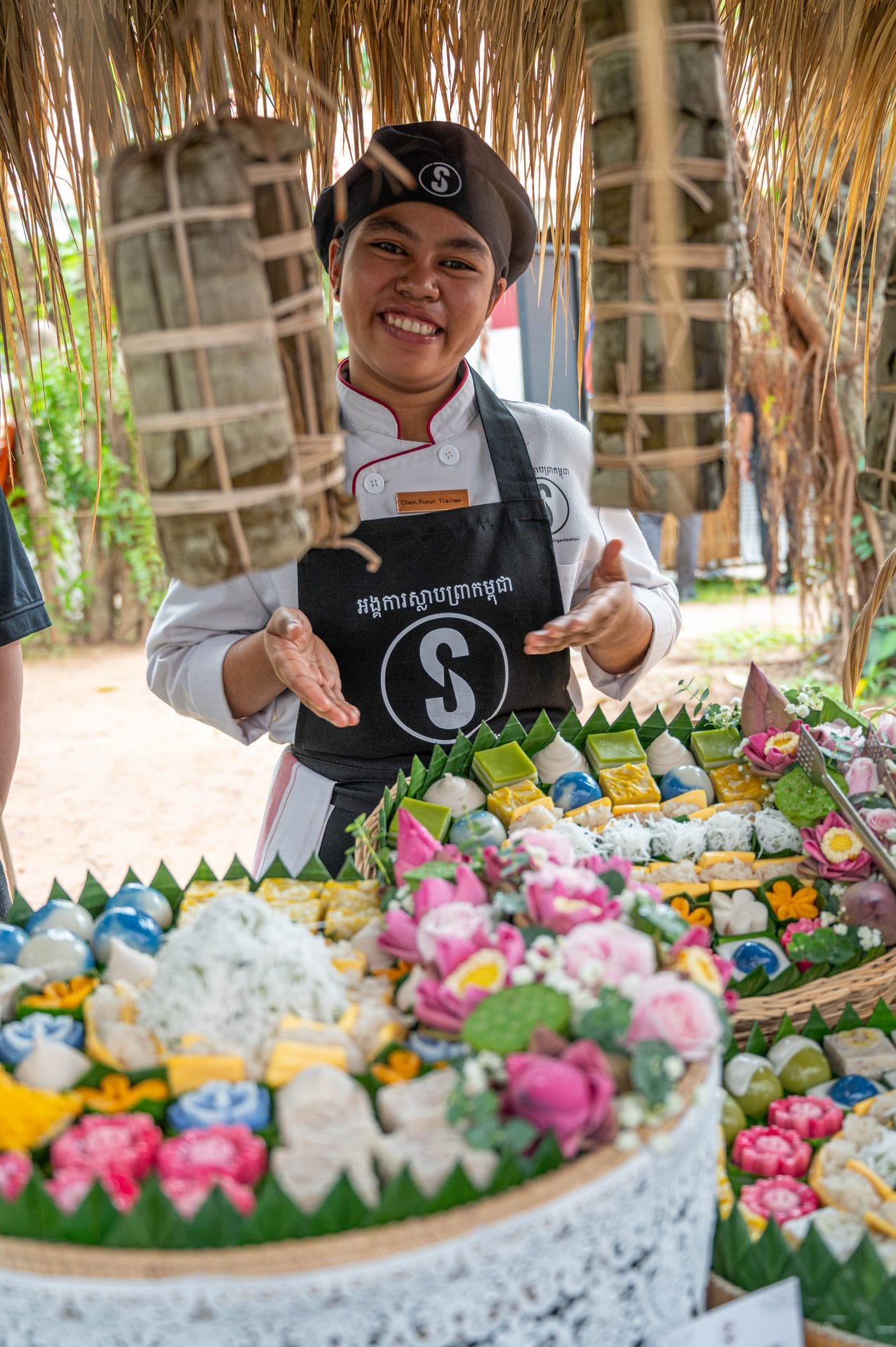
SPOONS is a social enterprise where the restaurant is the classroom. Around 75 young people from marginalized backgrounds train there each year, spending about 12 months learning culinary skills, service, barista work, baking, pastry and life skills while serving real customers. Khom Dara trained here and now works as a professional waiter, earning a stable income that supports his family and his sisters’ education. Planeterra’s Community Tourism Fund helped build the organic garden that supplies the kitchen.
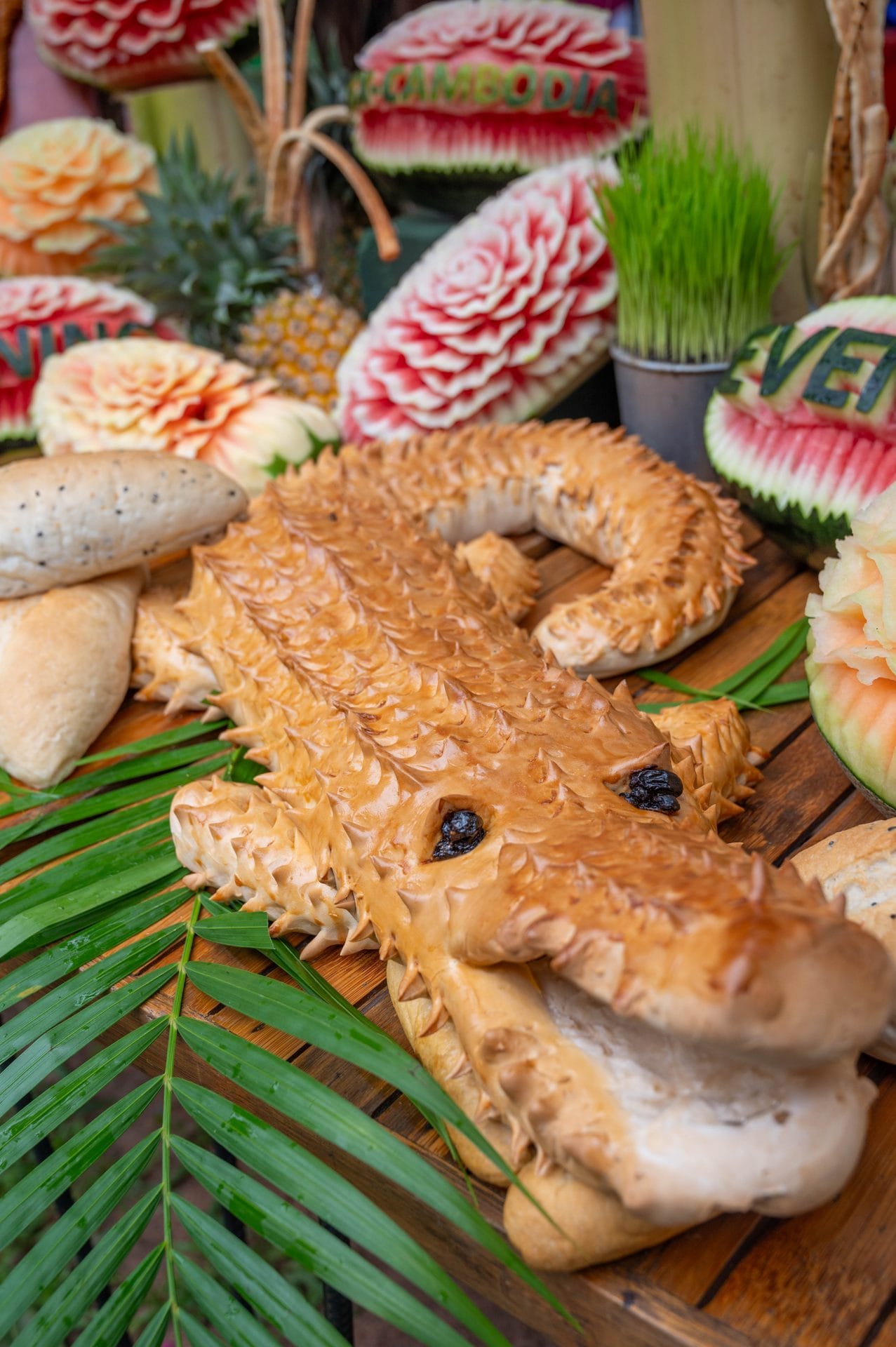
While the food was beautifully presented and appetizing it was mandatory that “my camera ate first.” The buffet stations were works of art: bread shaped like crocodiles, watermelons carved with messages, a stir-fry station, salad, fruit and vegetable bars, and desserts so beautiful they looked like paintings. I did two full laps just taking photos before I picked up a plate. If you’re in Siem Reap, you have to eat at SPOONS.
👉 Plan Your Visit: SPOONS Cafe Restaurant, Siem Reap. https://www.spoonscambodia.org/about-the-caf-and-restaurant
Floating Villages of Kampong Phluk and the Tonlé Sap
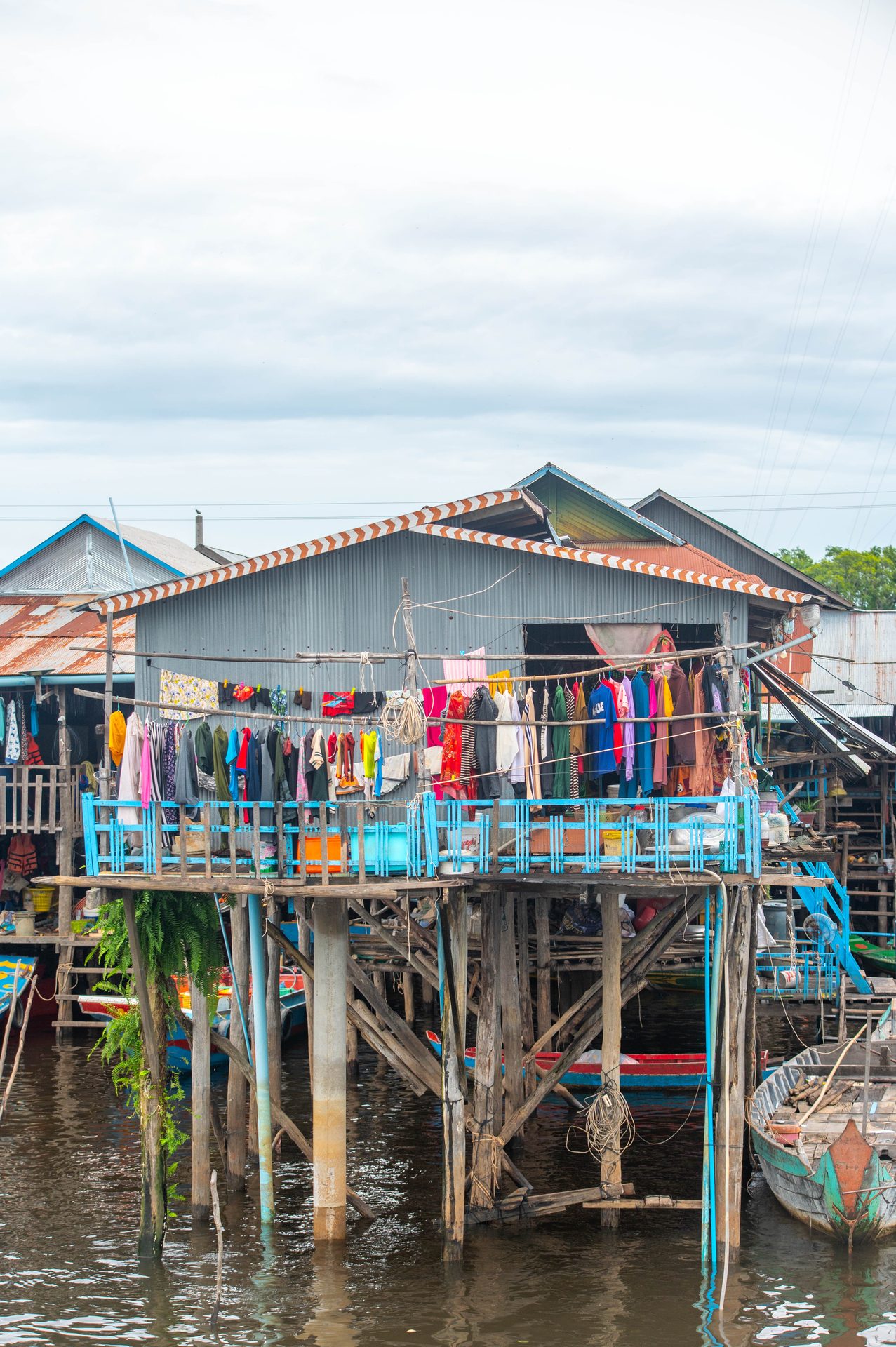
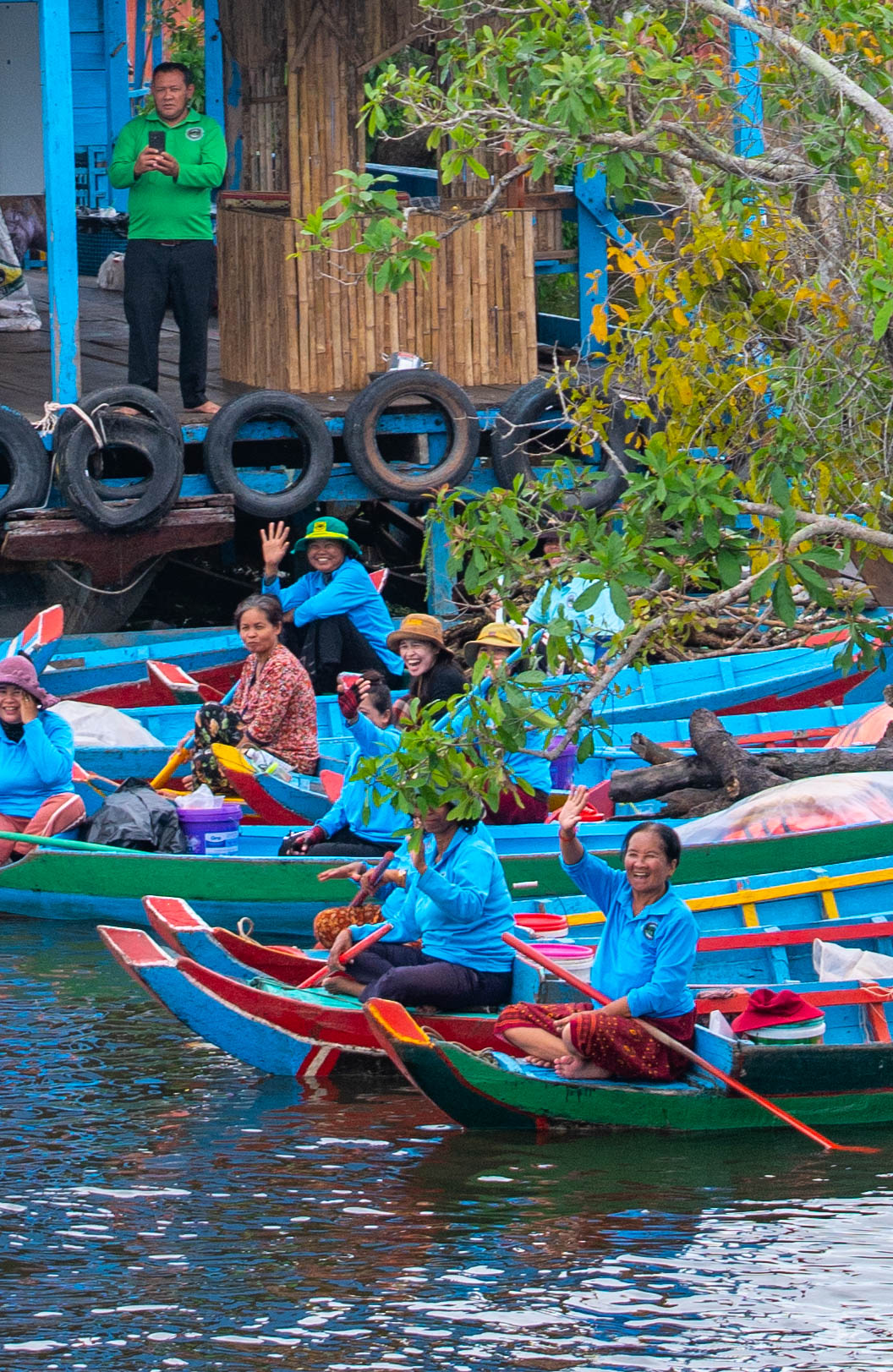
On the drive out, our guides turned the bus into a classroom. We learned that the Cambodian flag’s colours stand for nation, religion and king, and that the rumdul is the national flower; young women once tucked it into their pockets as perfume. We passed cashew orchards where kids hunt tarantulas from their burrows, and stalls selling crickets and grasshoppers. Our guide prefers crickets (“crispy!”). I photographed every insect I saw, but I wasn’t brave enough to eat one.
Then came the big secret from Day 2. Each rainy season, the Mekong swells so much that it forces the Tonlé Sap River to flow backwards, filling Tonlé Sap Lake. The lake grows from about 2,500 square kilometres in the dry season to as much as 16,000 at its peak. The flooded forest becomes a nursery for fish, and around 97% of the people who live here fish for a living, according to our guide.
This is why you travel. If you only want to see things you already know, you might as well stay home. We boarded long boats (no more than 15 people on the top deck at a time, and the engines are loud) and motored into Kampong Phluk at high water. I expected a handful of stilt houses. Instead, I found a full town on stilts, with a hospital, a community centre, restaurants and floating gas stations, and more than 1,000 boats tied to the community.
Women paddled out in small canoes, rafted up along the waterway and waved and sang as we passed. We traded hand-heart signs back and forth. Our guides said the village had rarely seen that many visitors at once, and the joy went both ways. A travel rule from G, we were asked not to photograph the children’s faces, and our leaders made sure we honoured it.
The community has its own plastic-reduction initiatives, and Planeterra provided 120 life jackets and safety training so women rowers and boat operators can welcome visitors safely. Siem Reap has four main floating villages: Chong Kneas is closest and busiest, while Kampong Phluk is known for its towering stilt houses.
👉 Plan Your Visit: Kampong Phluk is about an hour’s drive from Siem Reap. Water levels change dramatically by season; the houses look tallest in the dry months and the flooded forest is at its fullest from about September to November.
Where to Eat in Siem Reap: Bensley’s Bar at Shinta Mani
That night, we went from a lakeside village to a multi-course dinner at Bensley’s Bar at Shinta Mani Angkor, which is exactly the kind of range GAdventures does so well. Every plate was a work of art, and the food tasted even better than it looked. I sent so many photos and videos home to my foodie son and replied back with all sorts of fun “yum” emojis and gifs.
Shinta Mani’s Cambodian owner started a hotel school here in 2004, and it has grown into the Shinta Mani Foundation, which funds scholarships, clean water, nutrition for mothers and babies, and support for small businesses. We heard from two recent graduates, one of whom had finished her training just days before our dinner.
👉 Plan Your Visit: Bensley’s Bar, Shinta Mani Angkor, Siem Reap. Shinta Mani Angkor is also the hotel on GAdventures’ Signature: Laos and Cambodia’s Ancient Traditions trip.
Day 5 — Siem Reap: World Tourism Day at GX
The World Community Tourism Summit
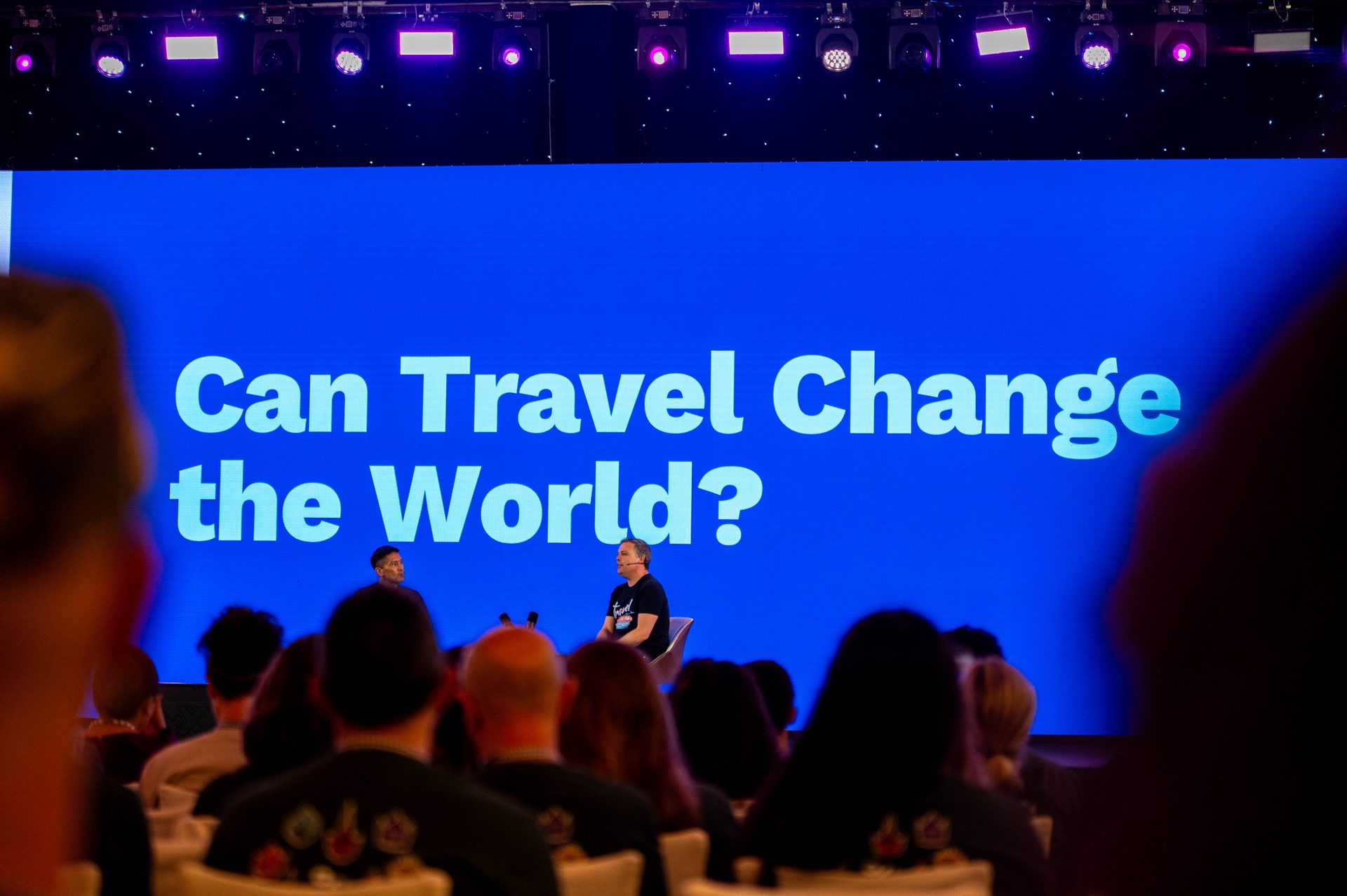
The bus was vibrating with contagious energy before we pulled into the Sokha Convention Center. It was as if GAdventures had hand-picked 600 people from its global community and said: let’s go somewhere iconic and show the world what community tourism can do. Was I at a Taylor Swift Eras Tour concert? A family reunion where everyone’s running around hugging? A birthday party where the food and drinks never stop? What is this creature GX has made? I think it sits at the intersection where community, hope, belief and family meet.
Phare Circus opened the day. It’s a performing arts academy that grew from an arts school founded by young Cambodians returning from refugee camps, and it now gives more than 1,200 students a tuition-free arts education, funded by its nightly shows. Cambodia’s Minister of Tourism, H.E. Huot Hak, welcomed us and hoped we’d leave with a “Spirit of Siem Reap.” Bruce Poon Tip told the room that Cambodia shouldn’t be a stopover between Thailand and Vietnam, and that our job was to go home and talk about it. (Consider this me doing my job!)
The day was packed with news. GX 2027 was confirmed for Brazil in September 2027. Project 300, G and Planeterra’s goal to add 300 community tourism enterprises to G itineraries by 2030, passed its halfway mark at 160. Trees for Days passed 6.7 million trees grown on behalf of G travellers. Planeterra unveiled a Community Positive Framework to measure tourism’s real impact. And G previewed Bazaar, a new platform launching in spring 2027 that will let you choose a trip by who you want to travel with, not just where.
👉 Practical Note: The convention centre’s air conditioning is strong, and you’ll be sitting all day. Bring long sleeves.
Nina Karnikowski and How to Travel Your Heart Out

Hands down, Australian journalist and author Nina Karnikowski was my favourite presenter of the day. She launched GAdventures’ new pocket guide, How to Travel Your Heart Out, and boiled its 35 ideas down to one word: presence.
Two of her ideas will change how I travel. First, put the camera down, just for a second. Say hello, learn someone’s name, ask a question, and then, if it feels right, ask before you take the photo. It will almost always be a better picture. Before you post, imagine 100, 1,000 or a million people doing what you’re about to share; would that place still be okay?
Second, remember you’re a guest, and follow your money. Skip the chain and find the real thing: the family-run restaurant, the homestay, the local guide, the artisan you can buy from directly. Nearly every stop in this itinerary does exactly that.
👉 Plan Your Visit: Learn more about GAdventures’ How to Travel Your Heart Out Philosophy: https://www.gadventures.com/travel-your-heart-out/
A Purple Party at Bayon Temple
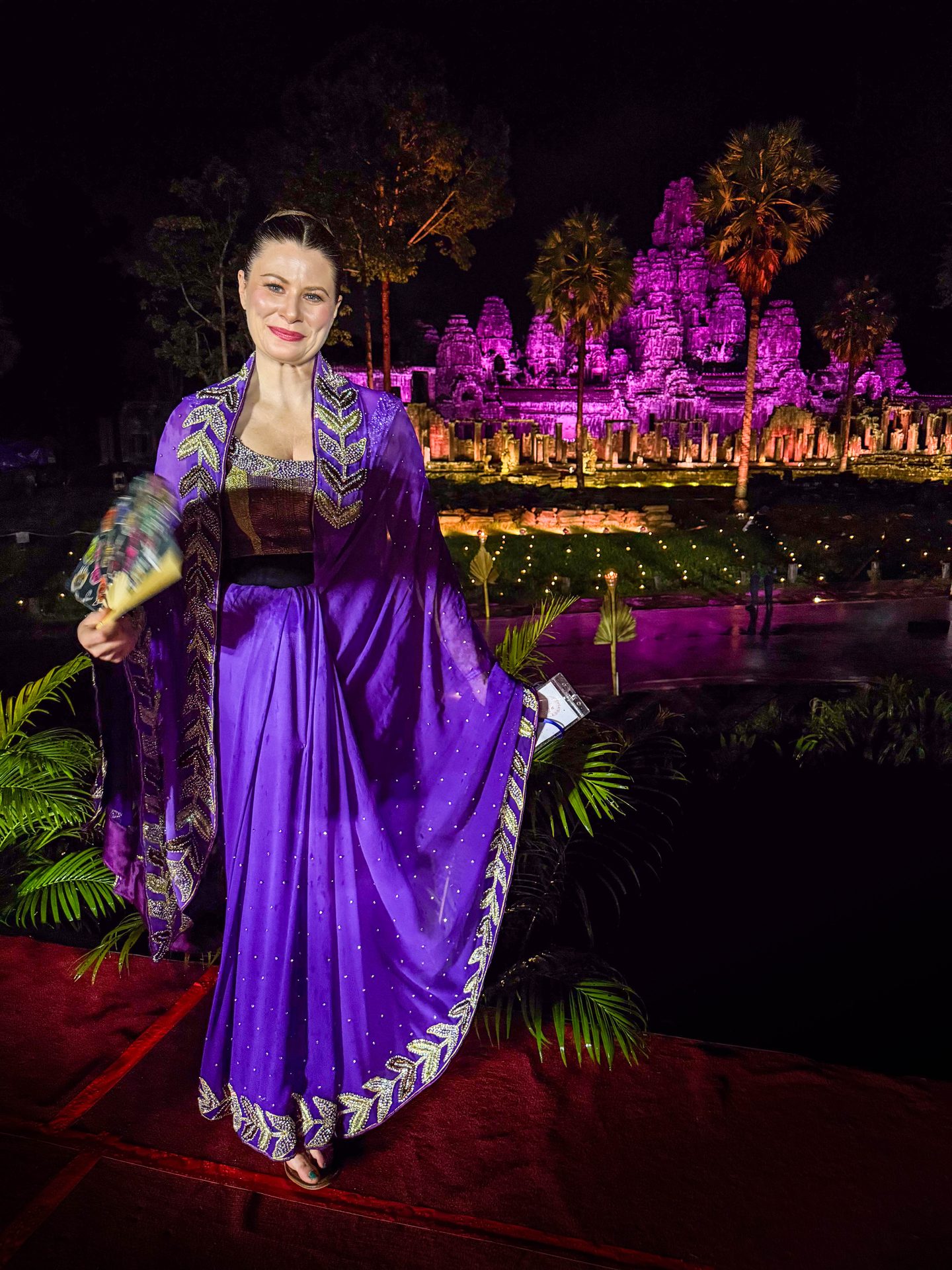
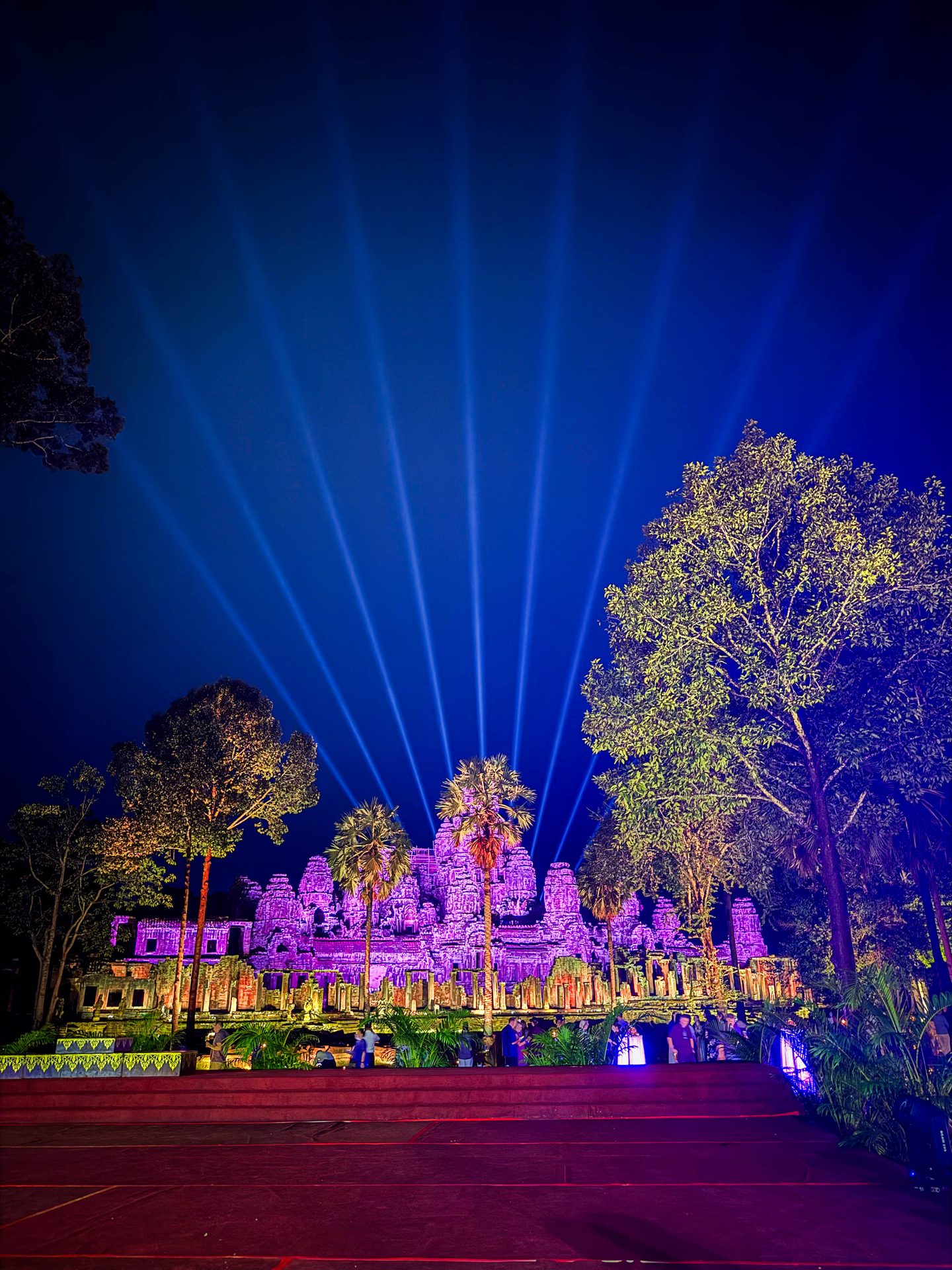
There are days you don’t forget because you can hardly believe they’re real while you’re living them. I was the very first person through the gates that night, greeted by drummers and monkey dancers. In front of me stood Bayon Temple, with its serene carved stone faces, lit up in GAdventures purple. Bayon sits in Angkor Thom, the walled royal city next to Angkor Wat, and it isn’t normally open at night. And yet, here we were, having the whole place to ourselves.
I’d brought a beautiful sari borrowed from a neighbour back home, and with my hair and makeup done (thank you again, Nak), I felt pretty glamorous. Everyone around me was dressed to the nines in purple. There were welcome speeches from Bruce, the Minister of Tourism, an Apsara dance, a Ramayana (Reamker) performance with more than 30 dancers, a live traditional band, food stations and an open bar. Bruce promised it would be one of the best parties on the planet. He was right, and the after-party at The Labyrinth kept it going late into the night.
I stood in front of the temple with colleagues who travel the world for a living, and we were all in shock and awe. Surprising people like us is not an easy task, and yet it felt like an Aladdin moment, as if GX had swept us off our feet for a magic carpet ride.
👉 What I Loved: Being the first one through the gates and seeing Bayon glowing purple before anyone else arrived.
👉 Plan Your Visit: The private Bayon evening was a GX event and isn’t bookable on its own. You can visit Bayon during regular Angkor park hours with your Angkor pass; go early or late in the day to see the faces in soft light. For an evening show in Siem Reap, book Phare, The Cambodian Circus.
Cambodia Itinerary Summary
I came to Cambodia nervous and under-informed, and I left humbled and grateful for the power of transformational travel through community tourism. In five days I went from a downpour of good energy at Wat Phnom to the silence of S-21, from 1,400-year-old temples being reclaimed by the jungle to a floating town that rises and falls with the lake. I met weavers, drivers, students, guides and community leaders, and every one of them made me feel welcome.
The biggest thing I learned is that how you travel matters as much as where you go. When your money goes to the right people, it stays in the community and shapes the next generation: kids in school instead of the fields, young people training at SPOONS and New Hope, women earning their own income behind the wheel of a tuk-tuk. Do your homework before you go, choose partners who put communities first, and Cambodia will give you far more than a photo of a temple.
Things to Do in Cambodia Beyond This Itinerary
A few more stops worth building into your own version of this trip:
- Ta Prohm — The jungle temple where giant trees grip the stones. Rhodri, one of my fellow storytellers, squeezed it in on his last morning.
- Angkor Thom and Bayon by day — See the stone faces in daylight with your Angkor pass.
- Phare, The Cambodian Circus — A nightly acrobatic show in Siem Reap that funds tuition-free arts education.
- Choeung Ek killing field — The memorial outside Phnom Penh that, with S-21, is part of the UNESCO-listed Cambodian Memorial Sites.
- New Hope Cambodia — The school and training restaurant outside Siem Reap where eight GAdventures CEOs got their start.
- Artisans Angkor — Fine Cambodian crafts; one of its artists live-painted Ta Prohm at the summit for a Planeterra fundraiser.
- Made in Cambodia market and the Siem Reap night market — Shop local makers, then treat yourself to an inexpensive foot massage near Pub Street.
- MeDha Cambodia — A collective of women drummers whose performances celebrate strength and identity. Follow @medhawomendrummers.
- Kampong Khleang — Another Tonlé Sap stilt village, featured on G’s Signature: Laos and Cambodia’s Ancient Traditions trip.
- Prek Toal bird sanctuary — Early-morning boat trips on the Tonlé Sap for serious birdwatchers.
- Shinta Mani Wild — Bill Bensley’s luxury tented camp in the Cardamom Mountains rainforest, for a splurge extension.
- The Elephant Bar at Raffles Hotel Le Royal — A historic cocktail bar in Phnom Penh, famous for its long gin list.
Practical Information for Planning Your Cambodia Itinerary
GX itself runs about five days but the GX tour runs 18 (which I think would be AMAZGIN!) If you’re building your own trip, plan seven to 10 days: two or three in Phnom Penh, a full travel day via Sambor Prei Kuk, and at least three in Siem Reap so you can explore Angkor at a gentler pace. Whatever you do, arrive a day early to beat the jet lag.
November to February brings the driest, coolest weather and the biggest crowds. Cambodia also promotes May to October as its “Green Season,” with lush landscapes, fewer visitors and the Tonlé Sap at its fullest by September and October. Expect downpours (we had plenty), but they rarely last all day. GX is timed around UN World Tourism Day on September 27, and GX 2027 is confirmed for Brazil that September.
This itinerary is for curious, community-minded travellers who want to understand a country, not just tick off its landmarks. It mixes luxury hotels with village homestays, and heavy history with joyful celebration, so come with an open heart.
If you’re considering GX Brazil 2027, know that GX brings together travel agents, suppliers, media, content creators, travellers and GAdventures staff across 10 tracks: Changemakers, Trailblazers, Architects, Believers, VIPs, Ambassadors, Storytellers, Creators, Community Camp and GOATs. Each track has its own programme, and everyone comes together for the summit and the final party. Stay tuned for registration updates on GAdventures website.
- Temple-appropriate clothing (shoulders and knees covered) and a light scarf
- Comfortable, grippy walking shoes
- Bug spray and a lightweight poncho; you can’t buy them at the pier or on Silk Island
- A small flashlight and a fully charged phone for the pre-dawn Angkor Wat sunrise
- Long sleeves for heavily air-conditioned venues
- A reusable water bottle and a daypack for transfer days
- Small US dollar bills
- Something purple for the GX party!
- Room for souvenirs, plus a plan to declare food such as Kampot pepper and chocolate, and plant-based crafts like water-hyacinth baskets, at Canadian customs
I flew Cathay Pacific via Hong Kong into Phnom Penh’s new Techo International Airport and would happily fly with them again. I left from Siem Reap Angkor International Airport, which is about an hour from town, and flew home on Turkish Airlines through Europe. If you connect through Bangkok on Bangkok Airways, the first leg is often a small propeller plane with a strict 7 kg carry-on limit that’s weighed at check-in. Several of my colleagues’ checked bags were left behind in Bangkok, so keep your valuables and a change of clothes in your carry-on.
Within Cambodia, you won’t need a car. You’ll get around by boat on the Mekong and the Tonlé Sap, by tuk-tuk in town (book a Tuk Tuk Lady driver if you can), and by coach between cities. The Grab app works well for rides in Phnom Penh and Siem Reap. If you travel with allergies like I do, tell every kitchen ahead of time; in my experience they went above and beyond.
Cambodia Is Waiting for You
I left Cambodia with a full camera roll, a long reading list and a deep respect for a people who have rebuilt so much and still greet strangers with such joy. GX showed me what it looks like when a whole global community travels with purpose, and what’s possible when a country’s own people lead the way.
Cambodia isn’t a stopover; it’s a destination that rewards anyone willing to look beyond the postcard. I’ll remember the glitter-rain at Wat Phnom, the hum of the silk looms, women in canoes waving across the flooded Tonlé Sap, and Bayon glowing purple under the stars.
Plan your trip. Cambodia is waiting, and so is Brazil.